
HuMOLYTE Founder Dr. Sourabh Kharait to Present Research at Microbiome 2026
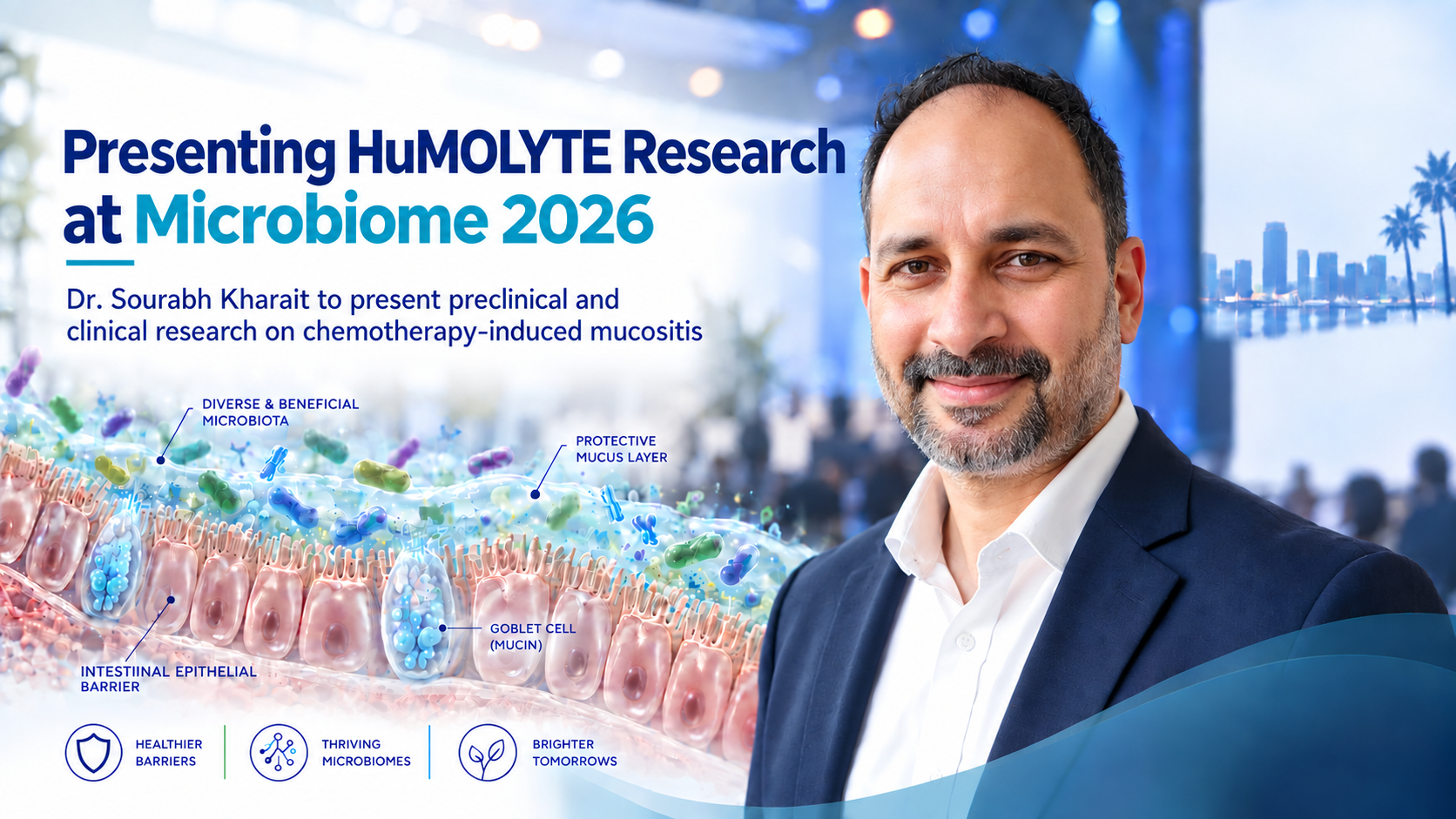
HuMOLYTE founder and CEO Dr. Sourabh Kharait, MD, PhD, will present new research on HuMOLYTE and chemotherapy-induced mucositis at the 14th Microbiome & Probiotics R&D & Business Collaboration Forum: USA, taking place October 1–2, 2026, in San Diego.
The conference brings together researchers, clinicians, life science companies, and microbiome innovators to discuss emerging research and the translation of microbiome science into real-world applications. This year's program includes research on gut health, inflammation, microbiome-based interventions, prebiotics, personalized nutrition, and the movement of microbiome discoveries from the laboratory into clinical use.
For HuMOLYTE, the presentation represents an important next step: connecting the company's peer-reviewed preclinical research with preliminary results from its first randomized human clinical trial.
From Preclinical Research to Human Clinical Data
Dr. Kharait's presentation will focus on the potential role of 2′-fucosyllactose, or 2′-FL, a human milk oligosaccharide (HMO), in supporting the mucosal barrier during chemotherapy.
Chemotherapy is designed to attack rapidly dividing cancer cells, but it can also damage healthy cells lining the mouth and gastrointestinal tract. This damage can contribute to oral and intestinal mucositis, which may cause mouth sores, diarrhea, inflammation, difficulty eating, dehydration, and other complications during cancer treatment.
HuMOLYTE is a medical food containing 2′-FL, magnesium, sodium, potassium, and other ingredients designed to provide nutritional and hydration support during chemotherapy.
The scientific question behind the research is straightforward: Could supporting the intestinal barrier help reduce some of the collateral damage chemotherapy causes to healthy tissue?
Dr. Kharait's presentation will examine that question using evidence from both preclinical and human research.
What the Preclinical Research Found
HuMOLYTE's preclinical research was published June 25, 2026, in the peer-reviewed journal Frontiers in Nutrition.
The study, titled “Supplementation with 2′-fucosyllactose, a prebiotic human milk oligosaccharide (HMO), in a magnesium-containing medical food reduces chemotherapy-induced mucositis in Wistar rats,” evaluated HuMOLYTE in several chemotherapy models.
Researchers studied animals receiving chemotherapy agents including doxorubicin, irinotecan, 5-fluorouracil, and cisplatin.
Among the findings, HuMOLYTE supplementation was associated with:
Reduced severity of chemotherapy-induced diarrhea
Reduced chemotherapy-associated weight loss
Better preservation of intestinal mucosal architecture
Preservation of mucus-producing goblet cells
Reduced inflammatory injury
Improved intestinal barrier function
Increased mucin secretion
The work is particularly relevant to microbiome research because the mucus layer and intestinal epithelial barrier form the interface between the gut microbiome and the rest of the body. When chemotherapy damages that barrier, the consequences can extend beyond digestion and hydration.
The published study provides a biological foundation for investigating whether those effects can translate into meaningful benefits in people undergoing chemotherapy.
Taking the Research Into the Clinic
That next step has now begun.
HuMOLYTE recently completed an open-label randomized controlled clinical trial involving 32 patients undergoing chemotherapy for solid tumors. Sixteen participants received standard oral hydration, while 16 received HuMOLYTE according to a defined dosing protocol beginning four days before chemotherapy. Patients were followed for four weeks.
Researchers evaluated both oral and gastrointestinal mucosal injury.
One of the clinical measures was the World Health Organization oral mucositis score. Across the four-week study, the mean score was 3.02 in the control group compared with 2.66 in the HuMOLYTE group, with the study reporting statistical significance at p<0.001.
Researchers also measured fecal calprotectin, a commonly used marker of intestinal inflammation and injury.
In the HuMOLYTE group, mean fecal calprotectin decreased from 160.13 µg/g at baseline to 48.34 µg/g at week two, approximately a 70% reduction. In comparison, the control group changed from 156.73 to 139.19 µg/g.
These results are preliminary and should be interpreted in the context of the study's size and design. The trial followed patients for only four weeks, representing a single chemotherapy cycle, and participants were permitted to use anti-emetic and anti-diarrheal medications. Longer studies across multiple chemotherapy cycles will be needed to better understand the potential clinical benefit.
Why Present This Research at a Microbiome Conference?
The connection between chemotherapy, the gut barrier, and the microbiome is becoming an increasingly important area of cancer-supportive-care research.
The Microbiome & Probiotics R&D & Business Collaboration Forum is designed specifically to bring together researchers working on the biology of the microbiome with companies and clinicians trying to translate those discoveries into practical interventions. Global Engage describes the conference as a meeting point for academic, clinical, and industry leaders working across microbiome science, prebiotics, probiotics, personalized nutrition, and commercialization.
That makes the conference a natural place to discuss HuMOLYTE's progression from mechanistic and animal studies toward human clinical research.
The broader question is no longer simply whether the microbiome matters during cancer treatment. Researchers are increasingly asking how the microbiome and the intestinal barrier can be supported in ways that translate into measurable patient outcomes.
HuMOLYTE's research is one piece of that larger scientific conversation.
About Dr. Sourabh Kharait
Dr. Sourabh Kharait, MD, PhD, is the founder and CEO of IGH Naturals and the inventor of HuMOLYTE.
He is an academic nephrologist and transplant physician who currently serves as Associate Professor of Medicine and Medical Director of the Living Donor Transplant Program at Banner – University Medical Center Tucson. His background includes transplant nephrology training at Columbia University and more than two decades of experience in nephrology, electrolyte disorders, clinical research, and medical nutrition.
His clinical experience treating patients with kidney and electrolyte disorders helped shape the original thinking behind HuMOLYTE: combining hydration and electrolyte replacement with nutritional ingredients intended to support the gastrointestinal system.
What began as a hydration problem has gradually become a much larger research question involving mucosal biology, HMOs, intestinal barrier function, and the microbiome.
Continuing the Research
The current human study is an encouraging step, but it is not the end of the research.
Future work is expected to evaluate HuMOLYTE over multiple chemotherapy cycles and investigate additional questions, including changes in the gut microbiome, inflammatory pathways, nutritional and functional status, and the longer-term effects of supporting the intestinal barrier during cancer treatment.
Dr. Kharait's presentation at Microbiome 2026 provides an opportunity to share those findings with researchers working at the intersection of microbiome science, nutrition, oncology, and translational medicine.
Sometimes the most interesting part of research is not a single result. It is watching a hypothesis move from mechanism, to animal model, to human study.
For more information on how HuMOLYTE can support your gut health during chemotherapy, visit our product page or consult your health care provider.
This blog was reviewed by Dr. Sourabh Kharait.
This blog is for educational purposes only and is not intended as medical advice. Always consult with your healthcare provider before making any changes to your treatment plan, hydration strategies, or diet. The information provided here is based on general insights and may not apply to individual circumstances.
