
What Is the Oral Mucositis Assessment Scale (OMAS)? How Researchers Measure Mouth Sores During Cancer Treatment
Oral mucositis can begin as redness and irritation inside the mouth and progress to painful ulcers that make eating, drinking, swallowing, and talking difficult. For patients receiving chemotherapy or radiation therapy, it can become much more than an uncomfortable side effect.
But there is a challenge for researchers studying oral mucositis: How do you objectively determine whether it is getting better or worse?
One important research tool is the Oral Mucositis Assessment Scale, commonly called OMAS.
OMAS is a validated clinical assessment method that measures the severity and extent of redness and ulceration at nine specific locations inside the mouth. Unlike some mucositis grading systems that incorporate symptoms such as pain or ability to eat, OMAS focuses primarily on what a trained evaluator can actually observe during an oral examination.[1]
That distinction makes OMAS particularly useful in clinical research evaluating cancer-treatment side effects and potential supportive interventions.
What Is Oral Mucositis?
Oral mucositis is inflammation and injury of the mucosal lining inside the mouth that can occur as a complication of cancer treatment, including certain chemotherapy regimens, radiation therapy involving the head and neck, and hematopoietic stem cell transplantation.
Symptoms can include:
Redness or inflammation
Mouth tenderness
Burning or sensitivity
Ulcers or open sores
Pain when eating or drinking
Difficulty swallowing
Increased sensitivity to certain foods
The severity can vary considerably from patient to patient.
That variability is one reason standardized assessment tools are important. If researchers simply described one patient as having "bad mouth sores" and another as having "mild irritation," it would be difficult to compare patients, treatments, or research studies objectively.
OMAS gives researchers a more systematic way to measure what is happening.
What Does OMAS Stand For?
OMAS stands for Oral Mucositis Assessment Scale.
The scale was developed and validated specifically to provide researchers with a simple, reproducible, quantitative method for evaluating oral mucositis associated with chemotherapy and radiation therapy.
The original multicenter validation study was published in Cancer in 1999 by Sonis and colleagues. Nine centers participated, evaluating 108 chemotherapy patients and 56 patients receiving radiation therapy.[1]
The investigators concluded that the assessment system was easy to use, reproducible between observers, responsive to changes over time, and strongly associated with patient symptoms.
How Does the OMAS Score Work?
OMAS examines two primary physical signs of oral mucositis:
Ulceration or pseudomembrane formation
Erythema, or redness of the oral tissue
Each is evaluated separately.
OMAS Ulceration Score
Ulceration is scored according to the approximate surface area involved.
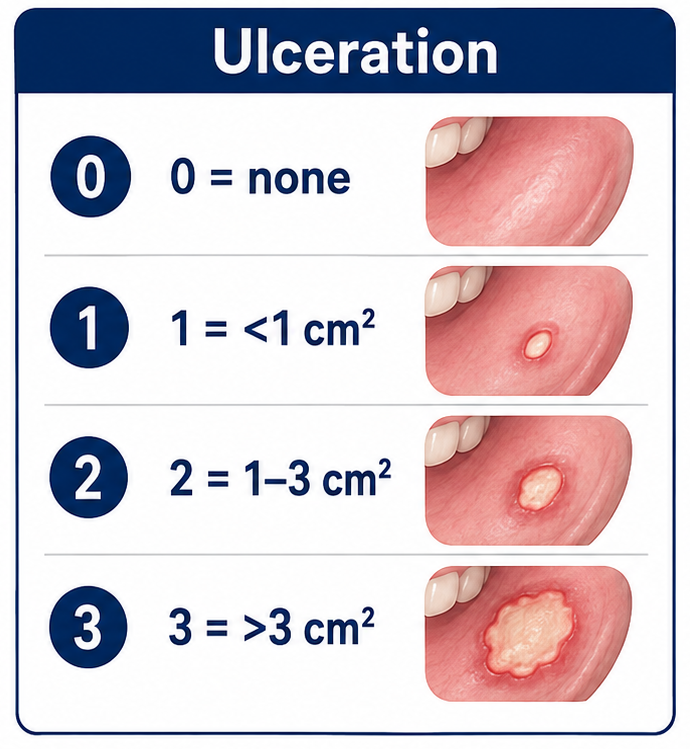
A larger area of ulceration therefore produces a higher score.
OMAS Erythema Score
Erythema refers to visible redness or inflammation of the oral mucosa.
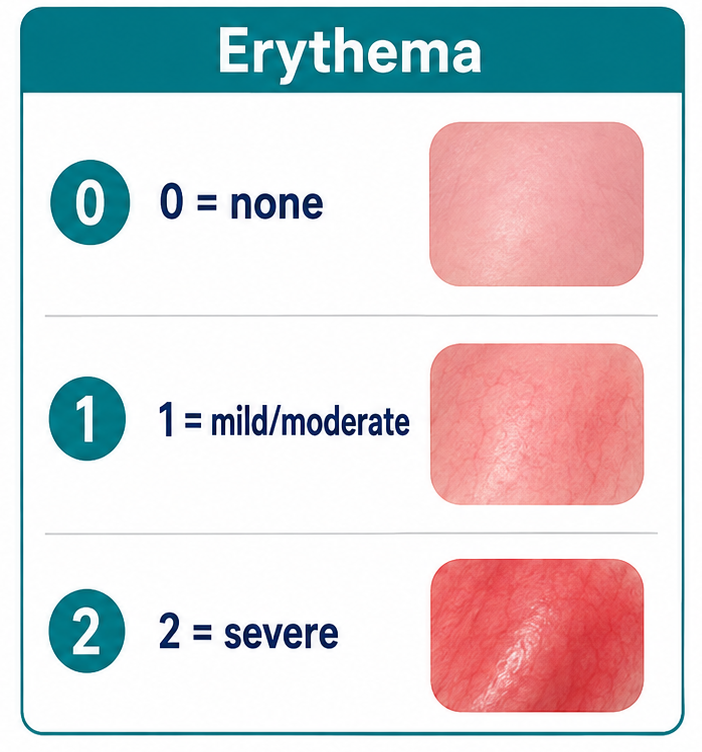
These assessments are performed at multiple predefined locations instead of simply looking at the mouth as a whole.
What Areas of the Mouth Does OMAS Evaluate?
OMAS evaluates nine anatomical areas:
Upper lip
Lower lip
Right cheek
Left cheek
Right side of the tongue
Left side of the tongue
Floor of the mouth
Soft palate/fauces
Hard palate
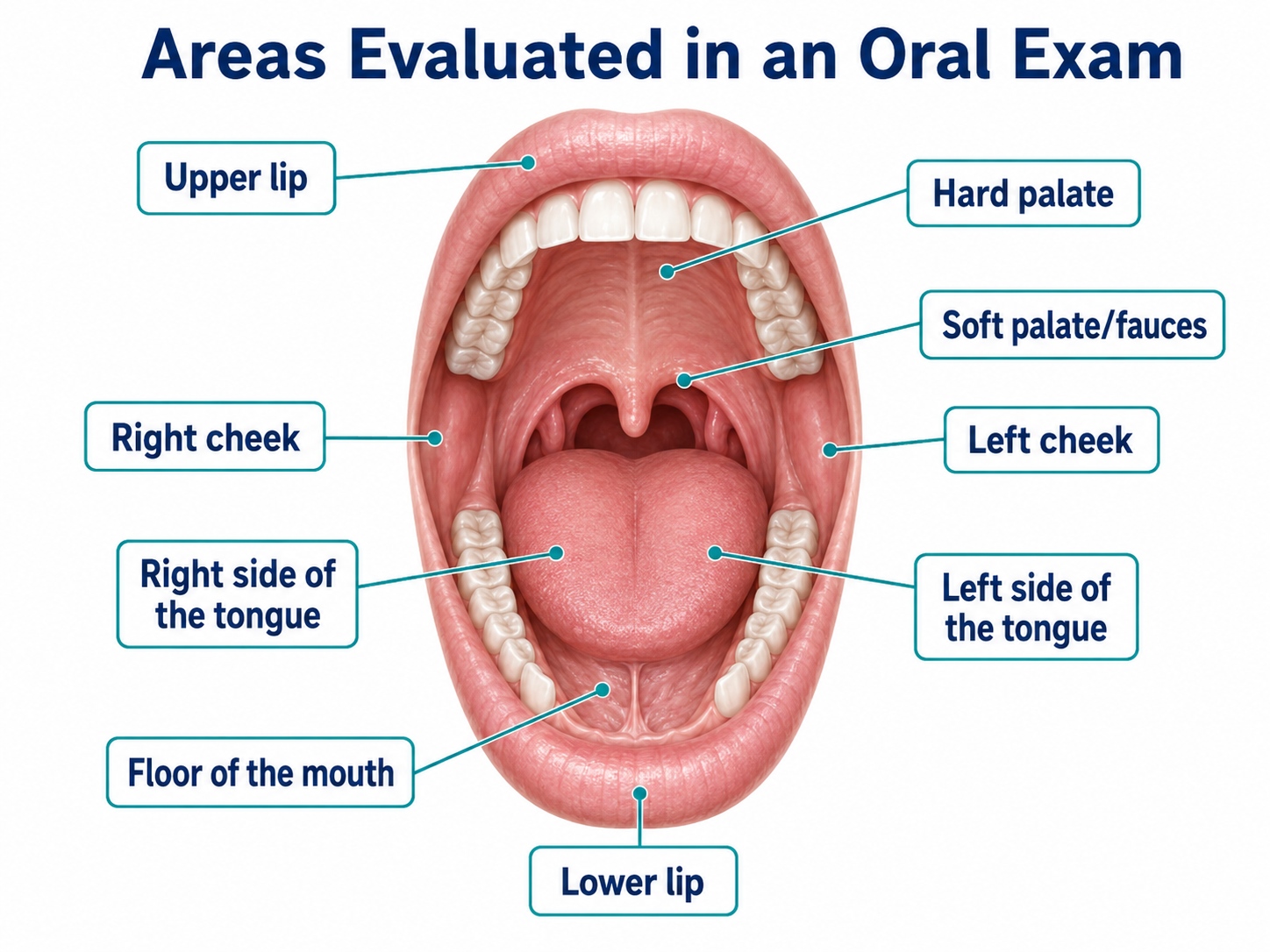
Each location is evaluated for both ulceration and erythema.
This is one of the major advantages of OMAS.
Imagine trying to measure damage after a storm by looking at an entire city from an airplane. You might know there was damage, but you would miss important differences between neighborhoods.
OMAS essentially goes neighborhood by neighborhood.
One part of the mouth may appear relatively normal while another has significant ulceration. Recording individual sites gives researchers a much more detailed picture of oral mucosal injury.
How Is the Overall OMAS Score Calculated?
OMAS should not be confused with a simple Grade 0–4 mucositis scale.
In the original validation work, investigators evaluated several methods for combining the individual site measurements.[1]
One commonly described mean OMAS score is calculated by taking:
Average ulceration score + average erythema score
Because ulceration can range from 0–3 and erythema from 0–2, the resulting mean score can range from:
0 to 5
A score closer to zero represents little or no observed oral mucositis, while a higher score reflects greater visible mucosal injury.
Researchers can also analyze changes in OMAS scores over time. This can be especially useful in clinical trials because it allows investigators to evaluate not simply whether mucositis occurred, but how its severity changed during treatment.
Why Is OMAS Useful in Cancer Research?
A major strength of OMAS is objectivity.
Pain is enormously important to the patient, but pain is also subjective.
Two people with similar mouth ulcers may describe their pain very differently. Pain medications may also reduce discomfort without necessarily changing the underlying tissue injury.
OMAS approaches the problem differently.
Instead of asking only, "How much does your mouth hurt?" an evaluator examines the oral tissue and records measurable physical changes.
That helps researchers answer questions such as:
Is there less ulceration?
Is the affected area smaller?
Is the oral tissue less inflamed?
Is mucositis developing more slowly?
Is the tissue recovering more quickly?
Are there measurable differences between treatment groups?
That level of detail is valuable when studying potential interventions designed to reduce the severity or duration of oral mucositis.
OMAS vs. the WHO Oral Mucositis Scale
OMAS is not the only way to evaluate oral mucositis.
Another widely used method is the World Health Organization Oral Toxicity Scale, commonly called the WHO oral mucositis scale.
The two approaches measure somewhat different things.
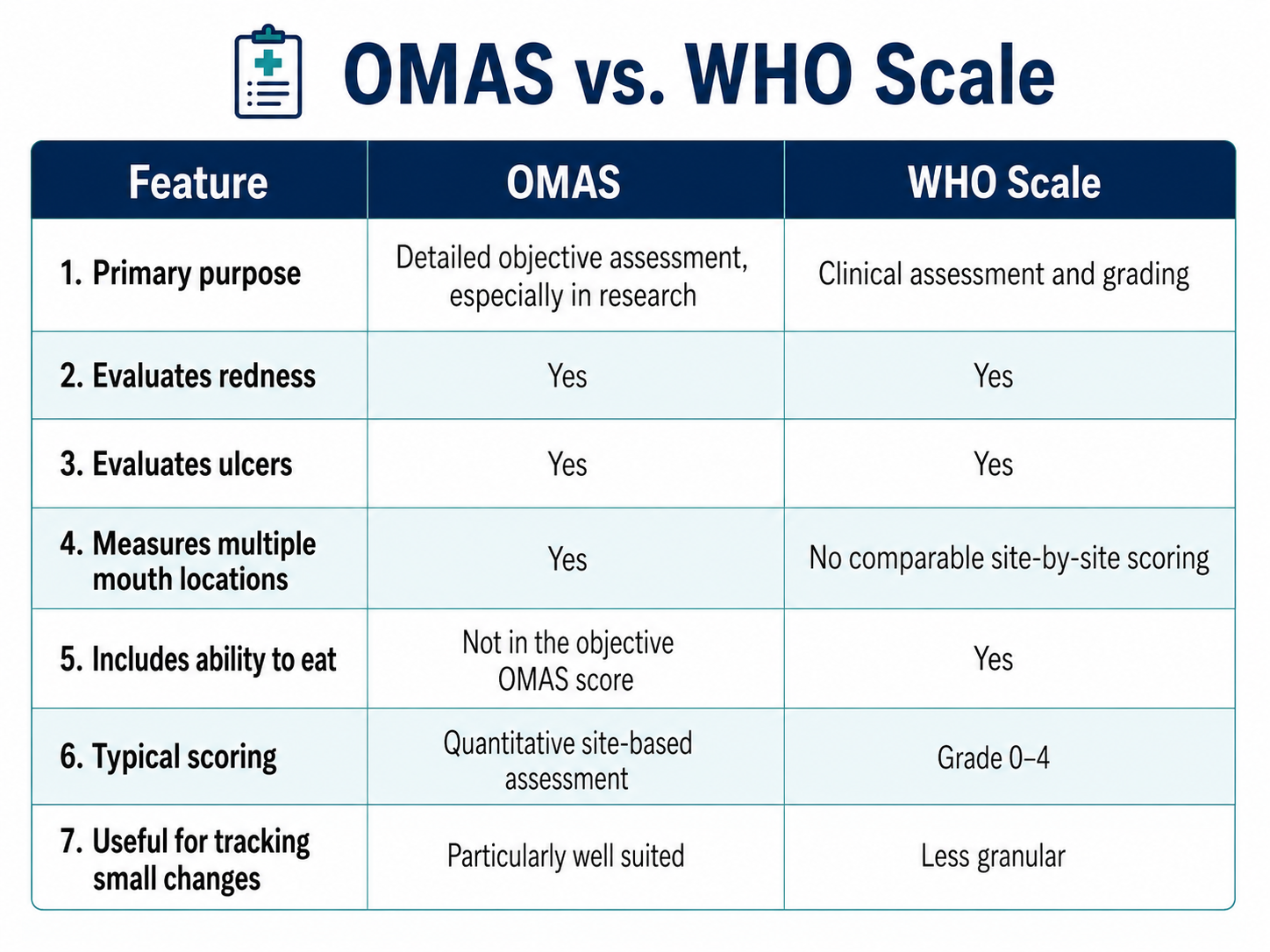
The WHO system combines physical findings with function.
For example, a patient's ability to eat solid food, consume liquids, or maintain oral intake can influence the WHO grade.
OMAS instead provides a more detailed assessment of the actual appearance of the oral mucosa.
Neither approach makes the other irrelevant. They are simply designed to answer somewhat different questions.
In fact, recent international guidance from the Multinational Association of Supportive Care in Cancer Mucositis Study Group found that the WHO scale remains a commonly recommended tool for clinician assessment in routine clinical practice. OMAS continues to have particular value when a detailed, site-specific measurement of mucosal injury is needed in research.[2,3]
OMAS vs. CTCAE
Cancer researchers may also use the Common Terminology Criteria for Adverse Events (CTCAE) developed by the National Cancer Institute.
CTCAE provides standardized terminology for reporting adverse events during clinical trials, including oral mucositis.
Again, the difference is largely one of purpose.
CTCAE helps researchers classify the clinical severity of an adverse event, while OMAS provides a more detailed examination of the physical changes occurring at multiple sites inside the mouth.
A clinical study may therefore use more than one type of assessment depending on its research objectives.
Does OMAS Measure Pain?
Not directly as part of its objective mucosal score.
This is an important distinction.
During the original validation of OMAS, researchers also collected information about pain, swallowing, eating, and analgesic use. Interestingly, objective mucositis findings showed strong associations with patient symptoms.[1]
However, pain and visible tissue damage are not exactly the same thing.
A patient can receive medication that substantially reduces pain while ulcers are still present. Conversely, a relatively small lesion in a sensitive location can cause considerable discomfort.
For that reason, researchers may pair objective assessments such as OMAS with patient-reported outcomes when they want to understand both what the tissue looks like and what the patient is experiencing.
Why Measuring Oral Mucositis Matters
Standardized measurements may sound like an academic detail, but they solve a very practical problem.
If researchers are evaluating a therapy intended to reduce oral mucositis, they need a reliable way to determine whether it actually worked.
Consider two groups of patients receiving chemotherapy.
If researchers simply ask whether patients developed mouth sores, both groups might appear similar.
But a detailed assessment might reveal that one group:
Developed smaller ulcers
Had less severe redness
Had fewer areas of the mouth affected
Reached peak mucositis later
Recovered sooner
Those differences can be difficult to capture with a simple yes-or-no measurement.
A standardized tool like OMAS can help quantify them.
Why OMAS Is Relevant to Supportive Cancer Care Research
Cancer treatment has become increasingly sophisticated, and supportive care research needs to keep pace.
The goal of supportive cancer care is not simply to treat the tumor. It is also to help patients tolerate treatment and manage the complications that treatment itself can create.
Oral mucositis is one of those complications.
When researchers investigate nutritional strategies, medical foods, medications, oral-care protocols, or other interventions intended to protect mucosal health, validated assessment tools help determine whether observed improvements represent measurable biological changes rather than impressions alone.
For HuMOLYTE, this is an important principle.
We believe supportive oncology products should increasingly be evaluated using measurable outcomes and well-defined clinical endpoints. Tools such as OMAS help researchers turn something as subjective-sounding as "my mouth feels better" into data that can be evaluated scientifically.
Patient experience still matters enormously. But pairing that experience with objective measurements gives researchers a much clearer picture.
The Bottom Line
The Oral Mucositis Assessment Scale (OMAS) is a validated method for objectively measuring oral mucositis caused by cancer treatment.
It evaluates both ulceration and erythema at nine locations inside the mouth, allowing researchers to track the location, extent, and severity of mucosal injury over time.
OMAS is particularly useful in clinical research because it provides more detailed information than a simple overall mucositis grade.
For patients, the scoring system itself may seem like a small technical detail. For researchers trying to determine whether a supportive-care intervention actually reduces mucosal damage, however, that detail matters.
Good research starts with good measurement.
FAQs
What is the Oral Mucositis Assessment Scale?
The Oral Mucositis Assessment Scale (OMAS) is a validated clinical research tool used to measure the severity of oral mucositis. It evaluates ulceration and redness at nine predefined locations inside the mouth.
What does OMAS stand for?
OMAS stands for Oral Mucositis Assessment Scale.
What does the OMAS score measure?
OMAS measures two observable characteristics of oral mucositis: ulceration or pseudomembrane formation and erythema (redness). These findings are assessed at nine sites within the oral cavity.
What is a high OMAS score?
A higher OMAS score generally indicates more severe visible oral mucosal injury. In the mean scoring method described in the original validation research, ulceration and erythema measurements can be combined into a score ranging from 0 to 5.
Is OMAS the same as the WHO mucositis scale?
No. The WHO oral mucositis scale assigns grades from 0 to 4 and considers both physical findings and a patient's ability to eat or drink. OMAS provides a more detailed, site-by-site assessment of visible ulceration and redness.
Does OMAS measure mouth pain?
The objective OMAS score does not directly score pain. It measures visible changes in oral tissue. Patient-reported pain and swallowing assessments can be collected separately alongside OMAS.
Who performs an OMAS assessment?
OMAS is designed for assessment by trained healthcare professionals or clinical research personnel. It is not intended to replace medical evaluation or serve as a self-diagnostic test for patients.
Is OMAS used for chemotherapy-related mouth sores?
Yes. OMAS was developed and validated in patients experiencing oral mucositis associated with chemotherapy and head-and-neck radiation therapy.
Why do clinical trials use OMAS?
Clinical trials can use OMAS because it allows investigators to objectively quantify changes in oral mucosal injury and compare severity across patients, treatment groups, and different points in time.
Can oral mucositis occur without severe pain?
Yes. Pain severity and visible tissue injury do not always correspond perfectly. Pain medication can also reduce symptoms without immediately eliminating the underlying mucosal injury. This is one reason objective assessments can be valuable in research.
References
For more information on how HuMOLYTE can support your gut health during chemotherapy, visit our product page or consult your health care provider.
This blog was reviewed by Dr. Sourabh Kharait.
This blog is for educational purposes only and is not intended as medical advice. Always consult with your healthcare provider before making any changes to your treatment plan, hydration strategies, or diet. The information provided here is based on general insights and may not apply to individual circumstances.
