About 4 in 10 Patients With Chemotherapy-Induced Neuropathy Develop Chronic Nerve Pain
A global review found that about four in ten people already diagnosed with chemotherapy-induced peripheral neuropathy reported chronic nerve pain.
That does not mean four in ten chemotherapy patients develop painful neuropathy. The statistic describes a group of patients who already had chemotherapy-induced peripheral neuropathy, or CIPN.
CIPN is nerve damage linked to certain cancer medicines. In the review, “chronic” meant symptoms lasting at least three months. The 40.78% painful-CIPN estimate was pooled from several studies rather than measured in one uniform patient group.
The certainty of the evidence was rated very low. This means the figure should be treated as a broad estimate, not as a prediction of what will happen to one patient.
What the 41% Statistic Actually Means
The denominator—the group being measured—matters.
Researchers looked at patients who had already been diagnosed with CIPN. Within that group, an analysis limited to painful CIPN estimated that 40.78% experienced chronic nerve pain.
The estimate does not apply to:
All people with cancer
All people receiving chemotherapy
Everyone exposed to a chemotherapy drug associated with neuropathy
Every patient who develops CIPN
Important: The 41% estimate applies to patients who already had chemotherapy-induced peripheral neuropathy—not to everyone receiving chemotherapy.
The corrected publication also reported a broader pooled estimate of 47.76% for patients with chronic moderate-to-severe CIPN or painful CIPN.
These outcomes overlap, but they are not identical.
Painful CIPN specifically involves nerve pain. Moderate-to-severe CIPN may include serious numbness, weakness, balance loss, or difficulty using the hands or feet, even when pain is not the main symptom.
What Is Chemotherapy-Induced Peripheral Neuropathy?
Peripheral nerves carry signals between the brain, spinal cord, hands, feet, muscles, skin, and other parts of the body.
Certain chemotherapy drugs can injure these nerves. The longest nerves are often affected first, which is why symptoms commonly begin in the fingers or toes.
Chemotherapy-induced peripheral neuropathy symptoms may include:
Numbness
Tingling or “pins and needles”
Burning sensations
Electric or shooting pain
Increased sensitivity to cold
Muscle weakness
Poor balance
Reduced coordination
Difficulty buttoning clothing
Trouble writing
Difficulty picking up small objects
Symptoms may gradually move upward from the fingers or toes into the hands, feet, arms, or legs.
CIPN Does Not Always Cause Pain
Some people with CIPN mainly experience:
Numbness
Tingling
Loss of sensation
Balance problems
Weakness
Reduced coordination
Other people develop:
Burning pain
Sharp pain
Shooting pain
Electric sensations
Pain caused by light touch
This is why “chemotherapy neuropathy” and “painful CIPN” should not be treated as identical terms.
Painful CIPN is one form of chemotherapy-related neuropathy. A person can have meaningful nerve damage and difficulty functioning without experiencing severe pain.
What Did the Global Review Examine?
The corrected publication included:
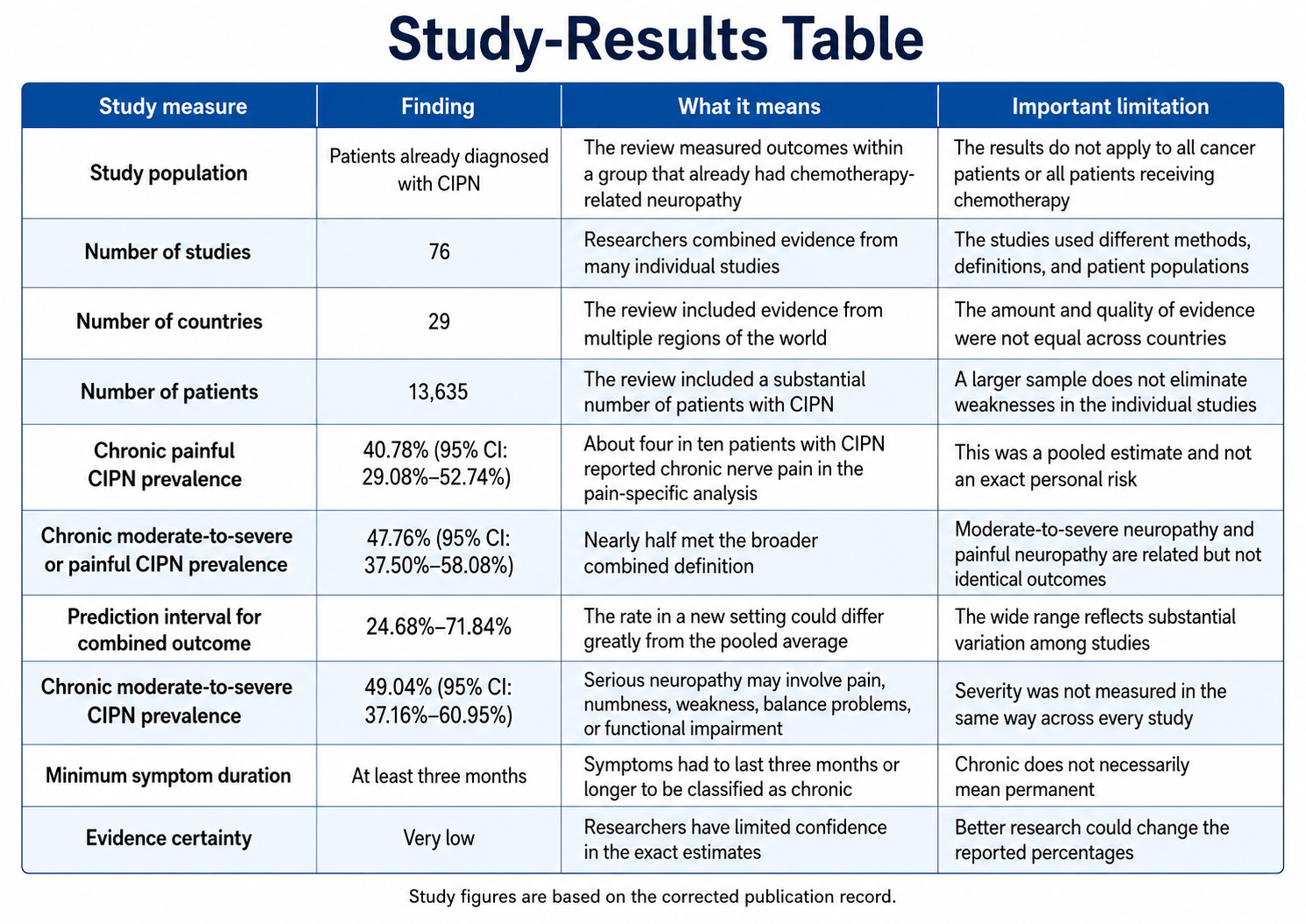
76 studies
29 countries
13,635 patients
Studies published between 2000 and 2024
Patients who had already been diagnosed with CIPN
Researchers combined the study findings to estimate how often chronic painful or moderate-to-severe neuropathy appeared among people who already had CIPN.
A systematic review collects and evaluates relevant studies using a planned method.
A meta-analysis combines numerical results from multiple studies to estimate an overall pattern.
This approach can provide a broader view than one small study. However, the result is only as reliable as the studies being combined.
What Did Researchers Find?
Among patients already diagnosed with CIPN, the meta-analysis estimated that:
40.78% had chronic painful CIPN in the analysis limited to studies that specifically measured pain.
47.76% had chronic moderate-to-severe CIPN or painful CIPN in the broader combined analysis.
49.04% had chronic moderate-to-severe CIPN in the analysis limited to studies measuring neuropathy severity.
Chronic symptoms lasted for at least three months.
The certainty of the evidence was rated very low.
The results also varied substantially between studies.
For the broader combined outcome, the prediction interval ranged from 24.68% to 71.84%. This wide range suggests that rates in a particular clinic, cancer population, or chemotherapy regimen may differ greatly from the overall average.
A pooled estimate combines results from multiple studies. It does not mean every clinic, cancer type, or chemotherapy regimen will have the same rate.
The study also does not predict an individual patient’s outcome.
What Does “Chronic” Mean?
The study defined chronic CIPN as symptoms lasting at least three months.
Chronic does not automatically mean permanent.
Some patients improve slowly after chemotherapy ends. Other patients continue to experience symptoms for months or years. The extent of recovery can depend on factors such as:
The chemotherapy drug
The total dose received
The severity of the initial nerve damage
Previous nerve problems
Diabetes or other health conditions
The amount of time since treatment ended
No study can predict with certainty how long one person’s symptoms will last.
Why Did the Estimate Vary Between Studies?
The studies included in the review were not identical.
They differed in:
Cancer types
Chemotherapy drugs
Total chemotherapy doses
Definitions of neuropathy
Pain-rating tools
Patient ages
Other health conditions
Follow-up periods
Study designs
Countries and healthcare systems
Researchers call this variation heterogeneity. In plain English, it means the studies were not measuring exactly the same patients in exactly the same way.
The very low evidence rating means researchers have limited confidence that the exact percentage will remain unchanged as better studies are completed.
The main lesson is not that every patient with CIPN faces a precise 40.78% risk. The main lesson is that chronic pain appears to be common among people who already have CIPN and deserves careful attention.
Which Chemotherapy Drugs Commonly Cause Neuropathy?
CIPN is associated with several groups of cancer medicines, including:
Taxanes, such as paclitaxel and docetaxel
Platinum-based drugs, such as oxaliplatin, cisplatin, and carboplatin
Vinca alkaloids, such as vincristine
Proteasome inhibitors, such as bortezomib
Immunomodulatory medicines, such as thalidomide and lenalidomide
Not everyone receiving these medicines develops neuropathy.
Risk may depend on:
The specific drug
The dose
The number of treatment cycles
Combination therapy
Previous nerve damage
Diabetes
Age
Kidney function
Other medications
Patients should ask their oncology team whether their particular treatment is known to affect peripheral nerves.
Can Neuropathy Continue or Worsen After Chemotherapy?
Yes.
CIPN symptoms may:
Begin during treatment
Continue after treatment ends
Improve slowly over time
Remain stable
Occasionally worsen for a period after treatment
The term coasting describes neuropathy that continues to worsen for a period after a chemotherapy drug has been stopped. It is especially associated with some platinum-based treatments.
Coasting does not happen with every chemotherapy drug or every patient.
Symptoms Patients Should Report Early
Tell the oncology team about:
New numbness or tingling
Burning or shooting pain
Increased cold sensitivity
Trouble walking
Balance problems
Falls or near-falls
Dropping objects
Trouble buttoning clothing
Difficulty writing
Foot numbness while driving
Weakness
Symptoms that interrupt sleep
Symptoms that worsen between treatment cycles
Do not wait until symptoms become severe.
Early reporting gives the care team time to monitor changes, evaluate other possible causes, and consider whether treatment adjustments could reduce the risk of worsening nerve injury.
Patients may also benefit from using a structured symptom log, such as an action plan for managing chemotherapy-induced neuropathy.
Can Chemotherapy-Induced Neuropathy Be Prevented?
No medication or strategy has been proven to prevent CIPN reliably for every patient.
Researchers continue to study approaches such as:
Exercise
Hand or foot cooling
Compression
Changes in chemotherapy delivery
Other protective treatments
The evidence differs depending on the chemotherapy drug and the method being studied.
Exercise may help patients maintain strength, balance, mobility, and physical function. However, exercise has not been proven to prevent CIPN reliably in all patients.
For broader guidance on staying active safely, patients can review information about exercise during cancer treatment and discuss appropriate activity with their care team.
Cooling or compression may not be appropriate for every chemotherapy regimen. Patients should ask their oncology team before trying either approach.
How Painful CIPN May Be Treated
Treatment depends on the patient’s symptoms, medical history, cancer treatment, and other medications.
The American Society of Clinical Oncology identifies duloxetine as the medication with the strongest evidence for established painful CIPN.
The average benefit is limited, and duloxetine does not eliminate pain for everyone. Side effects and possible drug interactions should be reviewed with the prescribing clinician.
In a randomized clinical trial, patients receiving duloxetine experienced greater pain reduction on average than patients receiving a placebo.
Other forms of support may include:
Physical therapy
Occupational therapy
Balance training
Fall-prevention planning
Referral to a pain specialist
Treatment of diabetes or vitamin deficiencies when relevant
Evaluation for other causes of neuropathy
Patients should not start, stop, or change medications without medical guidance.
Gabapentin, pregabalin, supplements, cannabis, acupuncture, and topical products have mixed or limited evidence for CIPN. They should not be presented as proven standard treatments.
When Chemotherapy May Need to Be Adjusted
When neuropathy becomes difficult to tolerate or interferes with daily function, the oncology team may consider:
Delaying treatment
Reducing the dose
Changing medicines
Stopping the nerve-damaging drug
The care team must balance cancer control with the risk of lasting nerve injury.
The right decision depends on the cancer, the treatment goal, how well the chemotherapy is working, and the severity of the neuropathy.
Patients should never skip, reduce, or stop chemotherapy on their own.
Protecting Against Falls, Burns, and Injuries
Reduced sensation can make injuries harder to notice.
Practical safety steps include:
Remove loose rugs and electrical cords.
Use handrails on stairs.
Improve lighting in hallways and bathrooms.
Use nightlights.
Wear supportive shoes.
Avoid walking barefoot.
Check hands and feet for cuts, blisters, or sores.
Test bathwater carefully.
Wear gloves when handling hot cookware.
Ask whether a cane or other mobility aid would help.
Consider physical or occupational therapy.
These steps do not repair injured nerves, but they can reduce avoidable harm while symptoms are present.
What Has Not Been Proven
No food, vitamin, supplement, or home remedy has been proven to reliably prevent or reverse CIPN.
Patients should discuss the following with their oncology team before using them:
Vitamin B supplements
Vitamin E
Acetyl-L-carnitine
Herbal products
Magnesium
Cannabis products
Over-the-counter “nerve support” supplements
Some products may be ineffective, interact with cancer treatment, or cause harm.
ASCO specifically recommends against using acetyl-L-carnitine to prevent CIPN because it has not been shown to help and may be harmful.
Questions to Ask the Oncology Team
Is my chemotherapy known to cause neuropathy?
What early symptoms should I report?
Should I track symptoms between treatment cycles?
Could another condition be contributing to my symptoms?
Would a dose adjustment be considered if symptoms worsen?
Is duloxetine appropriate for my painful neuropathy?
Would physical or occupational therapy help?
How can I reduce my risk of falls and injuries?
Are cooling or compression approaches appropriate for my regimen?
Which supplements or over-the-counter products should I avoid?
Frequently Asked Questions
Does the 41% estimate apply to all chemotherapy patients?
No. It applies to people who were already diagnosed with CIPN. The painful-CIPN estimate was 40.78%. It was not the risk for every person receiving chemotherapy.
What does chronic CIPN mean?
In this review, chronic meant symptoms lasting for at least three months. It did not automatically mean lifelong or permanent.
Does chemotherapy neuropathy always cause pain?
No. CIPN may cause numbness, tingling, weakness, balance problems, loss of sensation, pain, or a combination of symptoms.
Can CIPN begin after chemotherapy ends?
Symptoms may begin during treatment, continue afterward, or worsen for a period after some chemotherapy drugs have been stopped.
Which chemotherapy drugs commonly cause neuropathy?
Taxanes, platinum drugs, vinca alkaloids, bortezomib, thalidomide, and lenalidomide are among the medicines associated with CIPN. Risk varies by drug, dose, treatment schedule, and patient.
Can chemotherapy-induced neuropathy be prevented?
No strategy has been proven to prevent CIPN reliably in every patient. Patients should ask their care team about the evidence for any prevention approach being considered with their specific treatment.
Can CIPN be reversed?
Some patients improve over time. Other patients experience symptoms for months or years. No treatment can promise that CIPN will be reversed.
What medication is used for painful CIPN?
Duloxetine has the strongest guideline-supported evidence for established painful CIPN. Average pain relief is modest, and the medicine may not be appropriate for everyone.
Should mild tingling be reported?
Yes. Mild tingling may be an early warning sign. Reporting it allows the oncology team to monitor changes before symptoms become more serious.
Can neuropathy affect chemotherapy dosing?
Yes. Depending on symptom severity and treatment goals, the oncology team may consider a delay, dose reduction, drug substitution, or stopping the nerve-damaging medicine.
The Bottom Line
About four in ten people already diagnosed with CIPN reported chronic nerve pain in the corrected painful-CIPN analysis.
That estimate does not apply to every chemotherapy patient. The exact rate also remains uncertain because the studies differed considerably and the certainty of the evidence was very low.
The practical lesson is simple: report numbness, tingling, pain, weakness, or balance changes early. The oncology team—not the patient alone—should decide whether monitoring, rehabilitation, medication, or chemotherapy adjustments are appropriate.
Study Results

About Dr. Sourabh Kharait
Dr. Sourabh Kharait (MD / PhD) is Clinical Nephrologist and Medical Director of Clinical Trials at Summit Nephrology Medical Group, and the Founder and CEO of IGH Naturals, a platform company that designs Functional Foods and Nutritional products for athletes and patients with chronic diseases.Whatever it is, the way you tell your story online can make all the difference.
For more information on how HuMOLYTE can support your gut health during chemotherapy, visit our product page or consult your health care provider.
This blog is for educational purposes only and is not intended as medical advice. Always consult with your healthcare provider before making any changes to your treatment plan, hydration strategies, or diet. The information provided here is based on general insights and may not apply to individual circumstances.