
Enterade Advanced Oncology Review: Clinical Evidence, Ingredients, Cost, and Alternatives
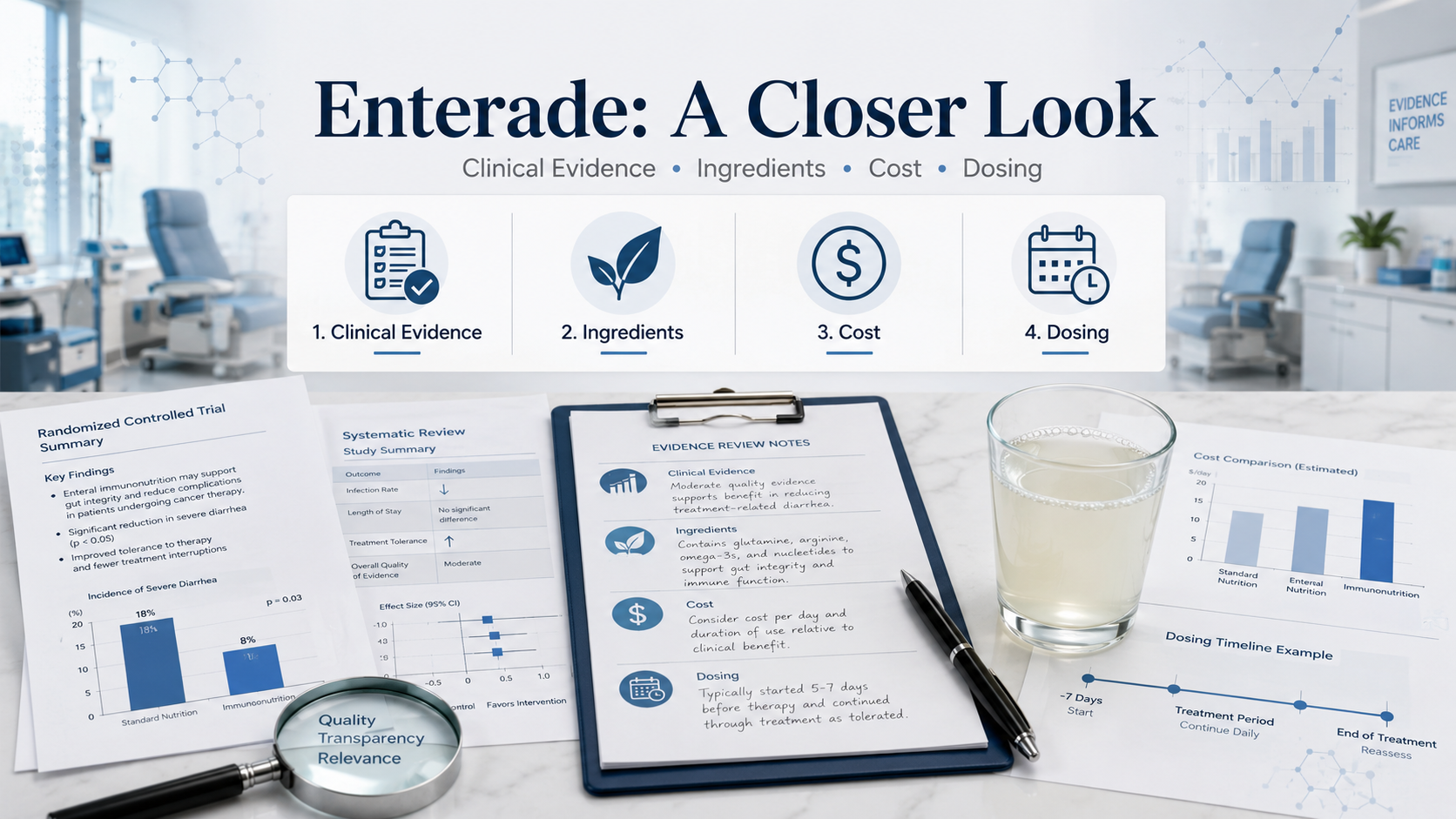
If you are undergoing chemotherapy and searching for ways to manage diarrhea, dehydration, or other gastrointestinal side effects, you may have come across Enterade Advanced Oncology.
Enterade is a medical food developed specifically for people experiencing gastrointestinal problems associated with cancer treatment. Unlike a conventional sports drink or electrolyte beverage, Enterade uses a proprietary blend of amino acids combined with electrolytes and is marketed for use under medical supervision during chemotherapy, radiation, and other cancer therapies.
But what exactly is in Enterade? What do the clinical studies actually show? How much does Enterade cost? And are there alternatives worth discussing with your oncology team?
This review takes a closer look at the published evidence.
Quick Answer: What Is Enterade Advanced Oncology?
Enterade Advanced Oncology is a glucose-free, amino acid-based medical food designed for the dietary management of gastrointestinal dysfunction associated with cancer treatment.
Its proprietary formula contains five amino acids—L-aspartic acid, L-valine, L-serine, L-threonine, and L-tyrosine—along with electrolytes and minerals. Enterade recommends typical use of two 8-ounce servings per day under the supervision of a healthcare provider.
Clinical research provides encouraging evidence that Enterade may help some patients with treatment-related diarrhea. However, the evidence is not definitive. One randomized controlled trial involving 114 patients did not find a statistically significant reduction in moderate-to-severe diarrhea in the overall study population, although a much smaller group of patients who successfully followed the protocol experienced substantially less diarrhea. Another small non-randomized study found significant improvements in diarrhea frequency and stool consistency.
The Oncology Nursing Society currently categorizes the effectiveness of Enterade for chemotherapy-induced diarrhea as "Effectiveness Not Established."
That does not mean Enterade does not work. It means the available research is promising but still limited.
What Is Enterade Advanced Oncology?
Enterade Advanced Oncology is produced by AmiLyfe Bioscience and is marketed as a medical food for patients undergoing cancer treatment.
This distinction matters.
A medical food is not the same thing as a dietary supplement, sports drink, or prescription drug. The FDA defines a medical food as a specially formulated food intended to be consumed or administered enterally under physician supervision for the specific dietary management of a disease or condition with distinctive nutritional requirements.
Medical foods generally do not undergo the FDA premarket approval process required for prescription drugs. The FDA specifically states that it generally does not "approve" medical foods before they are marketed.
Enterade does not require a prescription for purchase, although the company states that it is intended for use under healthcare-provider supervision. A prescription may be necessary if a patient is seeking insurance reimbursement.
What Ingredients Are in Enterade?
The main feature distinguishing Enterade from conventional hydration products is its proprietary amino-acid formulation.
According to Enterade's current patient information, the proprietary blend contains:
L-Aspartic Acid
L-Valine
L-Serine
L-Threonine
L-Tyrosine
Its ingredient list also includes sodium chloride, sodium citrate, potassium chloride, magnesium chloride, calcium chloride, natural flavoring, and stevia leaf extract. Enterade describes the oncology formula as glucose-free.
The current powdered Advanced Oncology product page emphasizes amino acids along with sodium and potassium as important components of the formulation.
Does Enterade contain magnesium?
Yes.
Enterade's published ingredient list includes magnesium chloride. However, the current publicly indexed product information we reviewed does not clearly state the amount of elemental magnesium delivered in each serving.
That is worth distinguishing from simply saying a product "contains magnesium." For patients receiving cancer therapies associated with electrolyte loss, the actual amount of an electrolyte may be relevant and should be discussed with the oncology team.
How Is Enterade Supposed to Work?
Chemotherapy does not exclusively attack cancer cells.
Many chemotherapy drugs affect rapidly dividing healthy cells as well, including cells lining the mouth and gastrointestinal tract. This can contribute to mucositis, diarrhea, impaired nutrient absorption, dehydration, and electrolyte loss.
Enterade's proposed approach is based on using selected amino acids to support intestinal cells and fluid absorption.
The company says its amino-acid formulation helps support the intestinal villi and GI barrier while promoting hydration without relying on glucose.
This is different from the mechanism used in conventional glucose-based oral rehydration solutions.
However, proposed biological mechanisms and demonstrated clinical outcomes are not the same thing. The more important question for patients is whether those mechanisms translate into meaningful benefits during actual cancer treatment.
That brings us to the clinical studies.
What Does the Clinical Evidence for Enterade Show?
Enterade has something many specialized nutritional products do not have: published human oncology research.
That is a genuine strength.
At the same time, the studies vary substantially in design, size, and strength of evidence.
Randomized Controlled Trial in High-Dose Chemotherapy
One of the most important Enterade studies was a prospective, double-blind, multicenter randomized controlled trial involving 114 patients receiving high-dose chemotherapy followed by autologous stem-cell transplantation.
Patients were randomized to receive either Enterade or placebo twice daily.
In the full intent-to-treat analysis, grade 2 or higher diarrhea occurred in:
36% of Enterade patients versus 50% of placebo patients.
Although that is a meaningful numerical difference, it did not reach conventional statistical significance:
p = 0.097.
The study encountered another important problem: compliance.
Severe nausea, vomiting, oral mucositis, difficulty swallowing, and other gastrointestinal toxicities made it difficult for patients to drink the assigned product twice every day. Only 13 patients met the study's full compliance criteria.
Among that very small compliant subgroup, the results were striking:
16% of Enterade patients developed grade 2 or higher diarrhea compared with 86% receiving placebo.
That difference was statistically significant at p = 0.025.
How should patients interpret this study?
The results are encouraging, but they need context.
The randomized trial provides evidence suggesting Enterade may reduce chemotherapy-related diarrhea in patients who can consistently consume it. But the primary intent-to-treat result was not statistically significant, and the dramatic 16% versus 86% result came from only 13 compliant patients.
The researchers themselves concluded that twice-daily administration was not feasible in this particularly sick population and recommended additional investigation in patients capable of maintaining oral intake.
That is not a failed study, but it also is not definitive proof.
2022 Study of Chemotherapy-Related Diarrhea
A second study published in the European Journal of Oncology Nursing examined Enterade in patients with solid tumors receiving systemic cancer therapy.
This was a non-randomized pilot study.
Twenty-two patients enrolled, and 16 completed both the pre-treatment and post-treatment assessments.
Researchers found statistically significant improvements in diarrhea-related outcomes, including:
Reduced stool frequency: p = .001
Improvement from watery toward more formed stool: p = .049
The study also found improvement in quality-of-life questions specifically related to bowel concerns. However, there was no statistically significant improvement in the patients' overall subjective quality-of-life measurement.
The authors concluded that Enterade appeared useful for reducing chemotherapy-related diarrhea but specifically stated that the findings should be replicated in a larger and more inclusive population.
This is another encouraging signal, but because there was no randomized control group and the final sample was only 16 patients, the findings should not be interpreted like a large randomized clinical trial.
Other Enterade Research
Enterade has also been evaluated in observational and retrospective studies.
One retrospective study examined patients with neuroendocrine tumors who experienced diarrhea. Of 49 patients with follow-up bowel-movement data, 84% reported fewer bowel movements, and 66% of those reporting improvement said bowel-movement frequency fell by more than half.
Another retrospective analysis examined 118 cancer patients experiencing treatment-related gastrointestinal symptoms and reported greater symptom improvement among people consuming Enterade for at least seven days. Because the study was retrospective rather than randomized, however, it cannot establish cause and effect with the same confidence as a controlled clinical trial.
Taken together, these studies create a reasonable scientific basis for continued investigation of Enterade.
They do not establish that every chemotherapy patient will benefit.
What Does the Oncology Nursing Society Say About Enterade?
An especially useful independent perspective comes from the Oncology Nursing Society (ONS).
ONS evaluates supportive-care interventions for chemotherapy-induced diarrhea and currently categorizes Enterade as:
Effectiveness Not Established
ONS specifically notes that the effectiveness of Enterade in the randomized stem-cell-transplant study was limited by patients' inability to tolerate the oral rehydration protocol.
This is a good example of why patients should look beyond phrases such as "clinically studied" or "clinically proven."
A product can have legitimate clinical studies while important scientific questions remain unanswered.
How Much Does Enterade Cost?
Enterade Advanced Oncology is available as powder stick packs and ready-to-drink formulations.
As of August 2026, Enterade's website lists the 10-stick starter pack at $35.90, or approximately:
$3.59 per serving.
Major retailers list a 30-count package for approximately $98.70, or:
$3.29 per serving.
Enterade's typical-use instructions call for two 8-ounce servings per day. The company labels its 30-stick option as approximately a two-week supply and its 60-stick option as approximately a one-month supply.
At the 30-pack retail price of $98.70, buying 60 servings at the same per-serving price would cost approximately $197.40 for 30 days, before any subscriptions, promotions, direct-purchase discounts, or insurance reimbursement.
Prices change, so patients should check current pricing before making treatment-budget decisions.
Will Insurance Pay for Enterade?
Possibly, but coverage is not guaranteed.
Enterade says some insurance plans may reimburse medical foods when prescribed for a medically necessary reason. The company provides reimbursement guidance and NDC codes patients can submit to their insurer.
Enterade itself does not directly bill insurance.
Patients considering reimbursement should ask their insurer specifically about coverage for medical foods, because coverage varies considerably among health plans.
How Do You Take Enterade?
According to Enterade, typical use is:
Two 8-ounce servings daily, according to healthcare-provider direction.
The company recommends taking Enterade approximately 30 minutes before eating or one hour after eating and says not to mix it with other products.
Enterade says it can be used before treatment begins and throughout treatment or while symptoms persist, under healthcare-provider supervision.
This timing requirement is worth considering.
During chemotherapy, nausea, taste changes, oral mucositis, poor appetite, and difficulty swallowing can make any nutrition or hydration protocol difficult to follow. In fact, this was one of the central challenges seen in Enterade's randomized high-dose chemotherapy study.
Adherence matters. A supportive-care product can only help if a patient can consistently consume it.
Is Enterade FDA Approved?
This question comes up frequently because Enterade is called a medical food.
The most accurate answer is:
Enterade is a medical food, not an FDA-approved drug.
FDA guidance states that medical foods generally do not undergo FDA's premarket drug-approval process. They are regulated as foods and must comply with applicable food-manufacturing and safety requirements.
"Medical food" therefore describes a regulatory category. It should not be interpreted as meaning FDA reviewed the product and determined that it treats or prevents chemotherapy side effects in the way FDA evaluates a pharmaceutical drug.
What Are Alternatives to Enterade During Chemotherapy?
There is no single best Enterade alternative because different patients are trying to solve different problems.
Someone experiencing mild dehydration may need something very different from a patient with severe chemotherapy-induced diarrhea, oral mucositis, persistent vomiting, or clinically significant electrolyte depletion.
Medical management can include oral or intravenous hydration, physician-directed antidiarrheal medications, anti-nausea medications, electrolyte replacement, diet changes, nutrition support, and treatment modifications depending on the cause and severity of symptoms.
Another emerging medical-food approach is HuMOLYTE, which uses a very different formulation from Enterade.
Enterade vs. HuMOLYTE: What Is the Difference?
Enterade and HuMOLYTE are both designed around nutritional support for patients experiencing gastrointestinal consequences of cancer treatment, but their formulations and proposed mechanisms are substantially different.
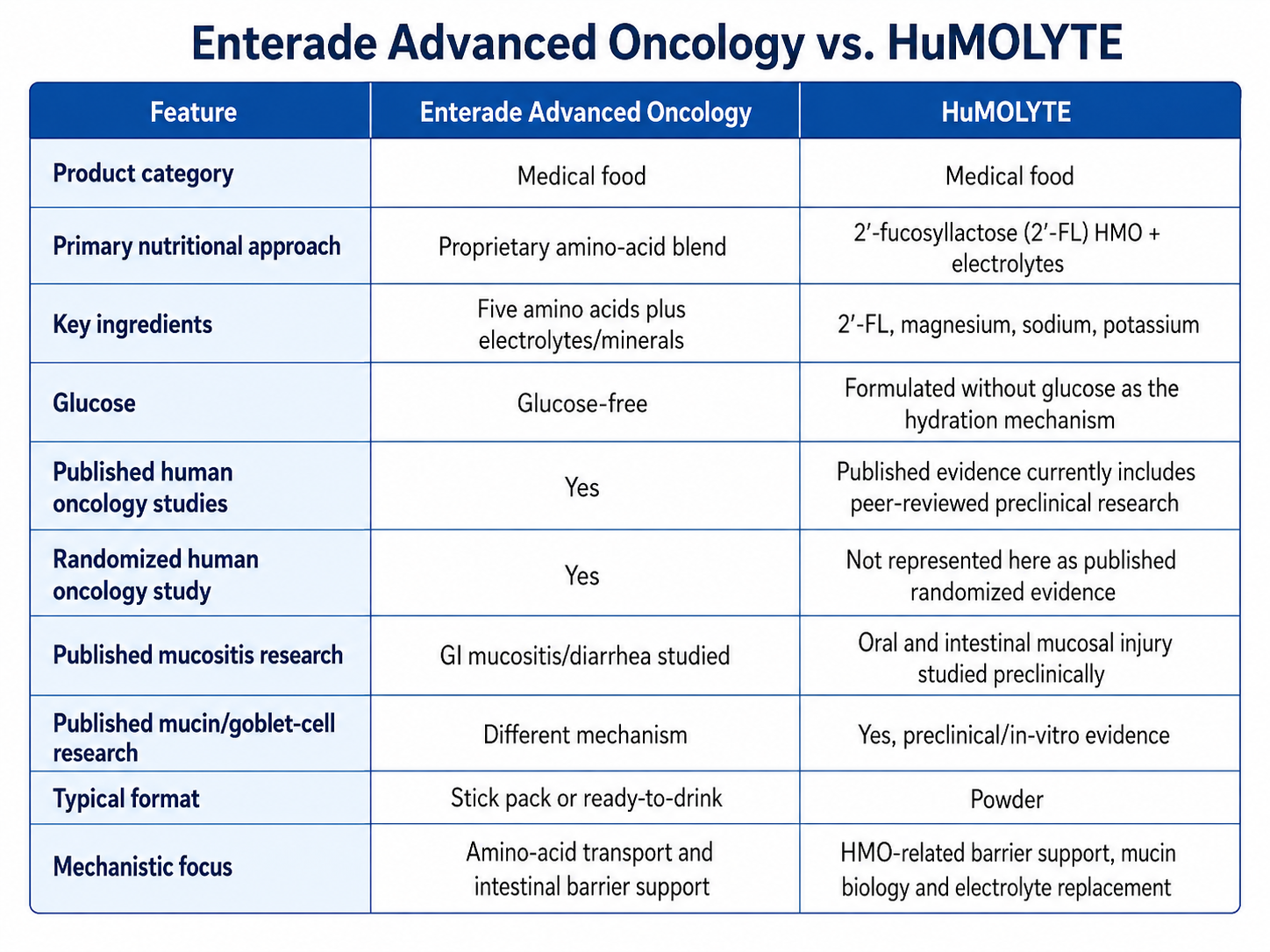
HuMOLYTE's published formulation contains 2 grams of 2′-fucosyllactose, 80 mg of elemental magnesium, 200 mg of sodium, and 150 mg of potassium per 4.5-gram serving.
2′-fucosyllactose, commonly shortened to 2′-FL, is a human milk oligosaccharide, or HMO. Despite the name, the 2′-FL used in nutritional products is not extracted directly from human breast milk.
In a peer-reviewed 2026 study published in Frontiers in Nutrition, researchers evaluated HuMOLYTE in Wistar rats exposed to four chemotherapy drugs: doxorubicin, irinotecan, 5-fluorouracil, and cisplatin.
Animals receiving HuMOLYTE experienced reduced diarrhea severity and less chemotherapy-associated weight loss in several experimental conditions. Tissue analysis showed preservation of intestinal mucosal anatomy and goblet cells, while laboratory experiments found improved goblet-cell viability, increased mucin secretion, and reduced epithelial permeability. Researchers also observed reduced chemotherapy-associated oral mucosal injury on histopathology.
The major limitation is important:
These published HuMOLYTE findings are preclinical.
Animal and cell-culture findings cannot be assumed to produce the same effects in humans.
That is also why comparing Enterade and HuMOLYTE simply by counting studies would be misleading. Enterade currently has more published human oncology research, while HuMOLYTE is investigating a different biological approach centered on 2′-FL, mucosal-barrier function, mucin, and electrolyte replacement.
HuMOLYTE is currently being prepared for commercial availability rather than being presented here as a product patients can immediately substitute for Enterade.
Is Enterade Worth Considering During Chemotherapy?
Enterade is one of the more scientifically developed nutritional products aimed specifically at cancer-treatment-related gastrointestinal problems.
Its strengths include a defined amino-acid formulation, human oncology research, a randomized controlled trial, additional observational studies, and years of commercial use.
The limitations are equally important to understand.
The largest randomized study did not demonstrate a statistically significant reduction in moderate-to-severe diarrhea across the entire randomized population. The strongest result appeared in a very small subgroup of patients able to comply with the protocol. Another encouraging chemotherapy study enrolled only 22 patients and was not randomized.
The evidence is therefore best described as promising but not definitive.
That conclusion is consistent with the Oncology Nursing Society's current designation of Enterade's effectiveness for chemotherapy-induced diarrhea as not yet established.
For patients, the practical question should not necessarily be:
"Does Enterade work?"
A more useful question is:
"Given my chemotherapy regimen, symptoms, nutritional status, medications, electrolyte levels, and ability to drink the product consistently, is Enterade appropriate for me?"
That is a conversation worth having with an oncologist, oncology nurse, or registered dietitian.
Frequently Asked Questions About Enterade
What is Enterade Advanced Oncology?
Enterade Advanced Oncology is a glucose-free medical food containing a proprietary amino-acid blend and electrolytes. It is intended for the dietary management of gastrointestinal dysfunction associated with cancer treatment under healthcare-provider supervision.
What ingredients are in Enterade?
Enterade lists five amino acids—L-aspartic acid, L-valine, L-serine, L-threonine, and L-tyrosine—along with sodium chloride, sodium citrate, potassium chloride, magnesium chloride, calcium chloride, flavoring, and, in most formulations, stevia leaf extract.
Does Enterade contain magnesium?
Yes. Enterade lists magnesium chloride among its ingredients, although the publicly available product information reviewed for this article does not clearly state the amount of elemental magnesium in a current serving.
Is Enterade a medical food?
Yes. Enterade is marketed as a medical food intended for use under healthcare-provider supervision. Medical foods are a distinct FDA-regulated food category and are not the same as prescription drugs.
Is Enterade FDA approved?
Medical foods generally do not undergo FDA premarket approval in the same way pharmaceutical drugs do. FDA states that it generally does not approve medical foods before marketing.
Does Enterade require a prescription?
No prescription is required to purchase Enterade. However, the company says it should be used under healthcare-provider supervision. A prescription may be needed when seeking insurance reimbursement.
Does Enterade help chemotherapy-related diarrhea?
Clinical studies suggest Enterade may reduce diarrhea in some patients, but the evidence remains limited. A randomized trial found a numerical reduction in grade 2 or greater diarrhea that was not statistically significant in the overall population, while a small compliant subgroup showed a statistically significant difference. A separate small non-randomized study found significant improvements in diarrhea frequency and stool consistency.
How much does Enterade cost?
As of August 2026, Enterade's website lists a 10-stick Advanced Oncology starter pack for $35.90. Retailers list a 30-stick package for approximately $98.70. Prices and discounts can change.
How often do you take Enterade?
Enterade says typical use is two 8-ounce servings per day, taken according to healthcare-provider direction. It recommends consuming the product approximately 30 minutes before eating or one hour afterward.
What are alternatives to Enterade?
Alternatives depend on the problem being managed and can include physician-directed oral rehydration, electrolyte replacement, medications, dietary strategies, oncology nutrition support, or other medical-food approaches. HuMOLYTE is being developed as a different medical-food approach centered on 2′-FL HMO, magnesium, other electrolytes, and mucosal-barrier support. Patients should discuss any nutritional intervention with their oncology team.
Final Thoughts
Enterade Advanced Oncology deserves more consideration than a typical electrolyte drink because it has been purpose-built for oncology patients and has undergone clinical research.
But patients deserve the full story.
The clinical evidence is encouraging without being conclusive. The randomized trial produced an interesting signal but encountered major adherence problems, while smaller studies suggest improvements in chemotherapy-related diarrhea that still need confirmation in larger controlled populations.
For patients comparing Enterade alternatives, the most important difference may ultimately be mechanism.
Enterade approaches the damaged gastrointestinal tract primarily through a proprietary amino-acid formulation designed to support intestinal function and hydration.
HuMOLYTE takes a different approach using the human milk oligosaccharide 2′-FL together with magnesium, sodium, and potassium, with published preclinical research examining mucosal injury, goblet-cell function, mucin secretion, intestinal permeability, diarrhea, and oral mucosal injury.
Neither approach should replace standard oncology supportive care.
The better question is which nutritional strategy has the right evidence, formulation, tolerability, and clinical rationale for an individual patient.
That decision should be made with the patient's oncology team.
References
Oncology Nursing Society. Enterade® for Chemotherapy-Induced Diarrhea.
For more information on how HuMOLYTE can support your gut health during chemotherapy, visit our product page or consult your health care provider.
This blog was reviewed by Dr. Sourabh Kharait.
This blog is for educational purposes only and is not intended as medical advice. Always consult with your healthcare provider before making any changes to your treatment plan, hydration strategies, or diet. The information provided here is based on general insights and may not apply to individual circumstances.
