
Human Milk Oligosaccharides (HMOs): What They Are and How They May Support Gut Health
Human milk oligosaccharides, or HMOs, are complex carbohydrates naturally found in human milk. Unlike lactose and many other carbohydrates, most HMOs are not primarily used as calories by the person consuming them. Many pass through the small intestine relatively intact and reach the colon, where certain gut bacteria can use them. One HMO called 2′-fucosyllactose, or 2′-FL, has become one of the best studied. Research in adults is growing, especially around the gut microbiome, but not every proposed HMO health benefit has been proven.
What Are Human Milk Oligosaccharides?
Human milk oligosaccharides are a large family of complex carbohydrates naturally present in human milk.
Researchers have identified well over 100 distinct structures, and some reviews describe approximately 200. The amount and mix can vary from one person to another and change during lactation. Genetics, including a person's secretor status, also affects which HMOs are present and in what amounts.
HMOs are among the most abundant solid components of human milk after lactose and fat. That abundance helped lead researchers to an interesting question: if infants do not digest most HMOs for energy, why are they there?
Much of the answer appears to involve interactions among HMOs, intestinal bacteria, gut cells, and the developing immune system.
HMO Is a Category, Not One Ingredient
It is important not to use the term HMO as though it describes one substance.
HMOs are a family of structurally different compounds. Examples include:
2′-fucosyllactose (2′-FL)
3-fucosyllactose (3-FL)
Lacto-N-neotetraose (LNnT)
Several sialylated HMOs, such as 3′-sialyllactose and 6′-sialyllactose
Different HMOs can interact with different bacteria and biological pathways. Evidence about one HMO therefore should not automatically be applied to every other HMO.
HuMOLYTE contains 2′-FL, not the full range of HMOs naturally found in human milk. The published HuMOLYTE formulation evaluated in 2026 contained 2′-FL along with sodium, potassium, and magnesium.
What Is 2′-Fucosyllactose?
2′-fucosyllactose, or 2′-FL, is one specific human milk oligosaccharide.
Chemically, it is built from a lactose core with an additional sugar called fucose attached to it. That makes 2′-FL a different carbohydrate from lactose itself.
2′-FL is one of the most widely researched individual HMOs. Advances in biotechnology now allow 2′-FL with the same basic molecular structure to be produced for use in nutritional products.
It is important to understand what it is not.
2′-FL is not a probiotic, because it is not a living microorganism. It is also not a drug or cancer treatment.
Why Don't Humans Digest Most HMOs?
Human digestive enzymes do not fully break down many HMOs.
As a result, much of what is consumed can pass through the upper digestive tract and reach the colon relatively intact. There, certain microorganisms have enzymes that allow them to use particular HMO structures.
This is one reason HMOs are studied as prebiotic substances.
A prebiotic is a substance selectively used by certain microorganisms in a way that may benefit the host. The scientific definition also requires evidence linking that microbial use to a health benefit.
That definition matters. Changing gut bacteria is interesting, but a microbiome change alone does not automatically prove that someone's health has improved.
How HMOs Interact With the Gut Microbiome
The gut microbiome is the community of bacteria and other microorganisms living in the digestive tract.
Some bacteria can ferment HMOs. During fermentation, microorganisms break these carbohydrates down and may produce compounds known as microbial metabolites, including short-chain fatty acids.
HMO intake may therefore influence:
Which microorganisms are more or less abundant
How different microorganisms compete for nutrients
Microbial metabolism
Production of substances such as short-chain fatty acids
The effect is more complicated than simply feeding "good bacteria" and starving "bad bacteria." The microbiome is an ecosystem, and the same microorganism may behave differently depending on its environment.
HMOs and Bifidobacteria
Bifidobacteria receive a great deal of attention in HMO research because certain Bifidobacterium species are especially well adapted to use selected HMOs.
The evidence is strongest in infants. HMOs help shape the early-life microbiome, and bifidobacteria often become prominent members of that community.
Adult evidence is newer, but several studies now show that supplementation with 2′-FL, alone or with other HMOs, can increase Bifidobacterium abundance in at least some adults.
However, more bifidobacteria should not automatically be interpreted as better health. Researchers still need to connect specific microbiome changes with meaningful outcomes such as fewer symptoms, improved function, or lower disease risk.
What Adult Studies Have Found
Adult trials provide some of the strongest evidence that 2′-FL can change the gut microbiome. They also show why microbiome changes and clinical benefits need to be considered separately.
Healthy adults: 100-participant randomized trial
A 2016 double-blind randomized controlled trial included 100 healthy adults. Participants received 2′-FL, LNnT, a mixture of the two, or placebo for two weeks. HMO doses ranged from 5 to 20 grams per day.
The supplements were generally well tolerated, although gastrointestinal symptoms were more common at higher doses. Researchers also observed changes in the intestinal microbiota, including increases in bifidobacteria.
Important limitation: The study lasted only two weeks, enrolled healthy adults, and primarily examined tolerance and microbiome changes rather than long-term clinical outcomes.
Older adults: 89-participant randomized trial
A 2025 randomized controlled trial studied 89 healthy adults age 60 or older. Participants received placebo, 1 gram of 2′-FL per day, or 5 grams per day for six weeks.
2′-FL increased intestinal Bifidobacterium levels and was associated with several metabolic and molecular changes. However, the study's primary immune endpoint—a change in cytokine response—was not met.
Important limitation: This was a relatively short study of healthy older adults. Microbiome and biomarker changes do not establish that 2′-FL prevents disease or meaningfully improves immune function.
After antibiotics: 37-participant randomized trial
A 2025 randomized trial studied 37 adults with overweight or obesity who completed the study. Everyone first received oral vancomycin for seven days. Participants were then randomized to placebo or 12 grams of 2′-FL per day for eight weeks.
After two weeks, microbial recovery from the antibiotic disruption was greater in the 2′-FL group. But that difference did not persist through the end of the eight-week intervention.
Important limitation: The study was small and involved a specific population following a specific antibiotic. The improvement in microbiome resilience was temporary.
Another randomized trial involving 60 people with irritable bowel syndrome found that a 10-gram mixture of 2′-FL and LNnT increased bifidobacteria after four weeks but did not produce a significant difference in overall gastrointestinal symptom severity compared with placebo.
Bottom line: Adult trials show that 2′-FL can change the composition of the gut microbiome, but researchers are still determining how consistently those changes translate into meaningful health outcomes.
What Research Suggests About the Intestinal Barrier
The intestinal barrier is the layer of cells and mucus that helps keep the contents of the gut separated from the bloodstream and surrounding tissues.
Several parts work together to form this barrier:
Intestinal epithelial cells
Proteins called tight-junction proteins that help connect those cells
Goblet cells, which produce mucus
The mucus layer itself
Scientists can also measure intestinal permeability, or how readily substances cross the intestinal cell layer.
Experimental studies suggest that 2′-FL may influence some of these processes.
For example, researchers using an adult gut microbiome simulator, Caco-2 intestinal cells, and human intestinal organoid-on-chip models found that fermentation of 2′-FL affected microbial metabolites and was associated with changes in permeability and tight-junction proteins.
Other laboratory studies have reported effects on goblet cells and mucin production.
These are valuable mechanistic findings, but they are not the same as demonstrating improved intestinal-barrier function in a patient.
Experimental research suggests that 2′-FL and metabolites produced during its fermentation may influence intestinal-barrier function, but the clinical significance in specific adult diseases remains uncertain.
Can HMOs Interact With Pathogens?
Some HMOs can act as molecular "decoys."
Certain microbes and toxins attach to specific carbohydrate structures on the surface of human cells. Because some HMOs resemble those structures, microbes may bind to an HMO instead of attaching to a cell.
This mechanism has been demonstrated for selected HMOs and organisms, particularly in laboratory and infant research. Different HMO structures can have different effects.
That does not mean HMO supplementation has been proven to prevent gastrointestinal infections in adults.
Adult infection prevention remains an area where more clinical evidence is needed.
How HMOs May Influence Immune Signaling
HMOs may affect immune signaling through several pathways.
Some effects may occur indirectly as HMOs change the microbiome and the metabolites produced by gut bacteria. Laboratory research also suggests possible interactions with intestinal cells and immune-related receptors.
But "influences immune signaling" is very different from saying something "boosts immunity."
The 2025 randomized trial in older adults illustrates this distinction well. Although 2′-FL changed Bifidobacterium abundance and several circulating biomarkers, researchers did not meet the trial's primary immune-response endpoint.
HMOs may influence immune signaling, but researchers are still determining which effects are clinically meaningful in adults.
Are HMOs Only for Babies?
No.
HMOs attracted scientific attention because they are naturally abundant in human milk and play important roles during infancy.
Today, individual HMOs such as 2′-FL can be produced for nutritional use, and researchers have conducted clinical studies in healthy adults, older adults, and adults with gastrointestinal conditions.
However, the adult evidence base is still much smaller than the infant evidence base.
Findings in infants therefore should not automatically be applied to adults.
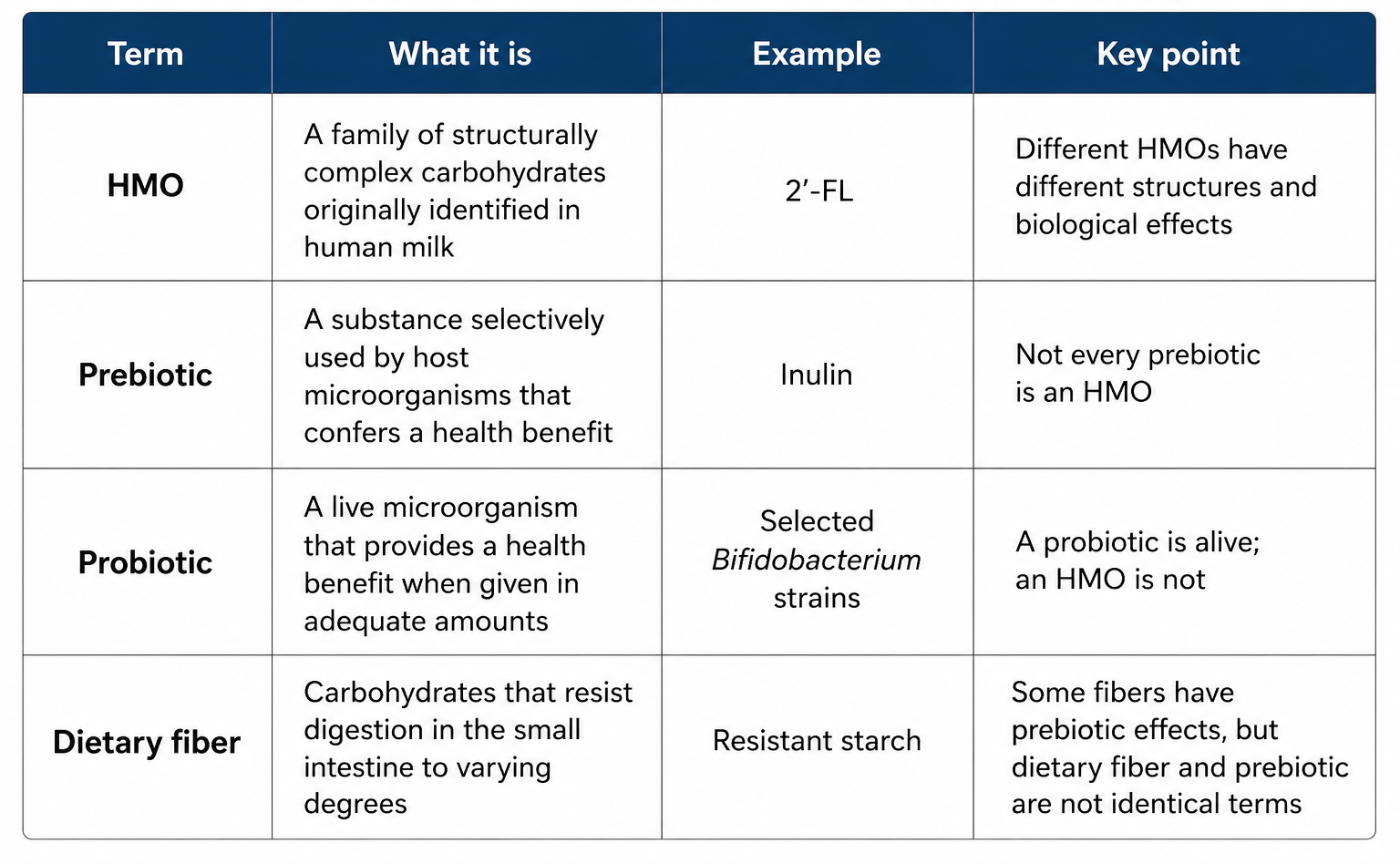
HMOs, Probiotics, and Other Prebiotics: What's the Difference?
These terms are sometimes used interchangeably, but they describe different things.
An HMO is a type of complex carbohydrate. A probiotic is a living microorganism. "Prebiotic" describes substances that are selectively used by microorganisms and provide a demonstrated health benefit.
Not every prebiotic is an HMO, and an HMO is not a probiotic.
See the comparison table following the article.
What Researchers Still Do Not Know About HMOs
Despite rapid growth in HMO research, several important questions remain unanswered.
Researchers still need to determine:
The best doses for different adult populations
Whether individual HMOs or combinations work best
Why some people show large microbiome responses while others show little response
How long microbiome changes persist after supplementation stops
Whether changes in microbiome composition consistently improve meaningful clinical outcomes
Whether HMOs benefit specific gastrointestinal diseases
The effects of long-term supplementation
How findings from infants translate to adults
How laboratory and animal findings about intestinal-barrier function translate to patients
How preclinical chemotherapy findings translate to people receiving cancer treatment
That uncertainty is not a weakness of the science. It is simply where the evidence currently stands.
Why HuMOLYTE Contains 2′-FL
HuMOLYTE contains 2′-FL, along with magnesium, sodium, and potassium. The peer-reviewed formulation evaluated in the 2026 HuMOLYTE study contained 2 grams of 2′-FL, 200 mg sodium, 150 mg potassium, and 80 mg magnesium per 4.5-gram serving.
2′-FL was selected because research has linked this HMO with the microbiome, mucus production, and intestinal-barrier biology.
HuMOLYTE is intended as supportive nutrition. It is not a cancer treatment and should not be presented as one.
The general scientific evidence about 2′-FL also needs to be kept separate from research on HuMOLYTE itself because HuMOLYTE contains several ingredients.
What HuMOLYTE's Chemotherapy Research Found
Preclinical evidence
A peer-reviewed study published in Frontiers in Nutrition on June 25, 2026 evaluated the complete HuMOLYTE formulation in Wistar rats and laboratory intestinal-cell models.
The animal study tested four chemotherapy drugs:
Doxorubicin
Irinotecan
5-fluorouracil
Cisplatin
Animals received HuMOLYTE beginning five days before chemotherapy. Researchers monitored diarrhea, body weight, and intestinal and oral tissue changes.
In the animal models, researchers reported that HuMOLYTE was associated with improvements in several measures, including reduced diarrhea severity with some chemotherapy drugs, less weight loss, lower tissue-injury scores, preservation of goblet cells, and less inflammation in intestinal tissue. Oral tissue injury was also lower in supplemented animals.
Researchers separately exposed intestinal-cell models to cisplatin. In those laboratory experiments, the HuMOLYTE formulation was associated with improved goblet-cell survival, greater mucin production, and improved measures of epithelial-barrier integrity.
These findings provide a scientific basis for additional research. They do not establish that the same results will occur in people receiving chemotherapy.
What Should Cancer Patients Know Before Using HMO Products?
Cancer treatment can change fluid needs, kidney function, electrolyte levels, digestion, and nutrition.
Patients should discuss HMO-containing nutritional products and electrolyte products with their oncology team, especially if they have kidney disease, fluid restrictions, abnormal electrolyte levels, severe diarrhea, repeated vomiting, bowel obstruction, feeding tubes, or other complex medical conditions.
Severe diarrhea and vomiting can lead to dehydration quickly. Patients should contact their care team when symptoms are severe, persistent, or interfere with their ability to drink.
Oral supportive nutrition also does not replace IV hydration when IV treatment is medically necessary.
For practical advice on diet, fluids, symptoms, and when to call the care team, use HuMOLYTE's separate Gut Health During Chemotherapy resource rather than relying on this HMO science article alone.
Frequently Asked Questions
What are human milk oligosaccharides?
HMOs are a diverse group of complex carbohydrates naturally found in human milk. Many are not fully digested by human enzymes and can instead interact with intestinal microorganisms and gut cells.
Is 2′-FL an HMO?
Yes. 2′-fucosyllactose, or 2′-FL, is one specific HMO and one of the most extensively studied.
Is 2′-FL the same as lactose?
No. 2′-FL contains a lactose-based structure with an additional fucose molecule attached, making it a different carbohydrate from lactose.
Are HMOs probiotics?
No. Probiotics are live microorganisms. HMOs are carbohydrates.
Are HMOs prebiotics?
Selected HMOs have prebiotic properties because certain microorganisms can selectively use them. Scientifically, the term prebiotic also requires evidence that this microbial use provides a health benefit.
Can adults consume HMOs?
Yes. Several randomized clinical trials have tested 2′-FL and other HMOs in adults. Research is still much more extensive in infants.
Do HMOs increase Bifidobacteria?
Several adult studies have found increased Bifidobacterium abundance after supplementation with 2′-FL or HMO combinations. Responses vary among individuals, and increased bifidobacteria alone does not prove improved health.
Do HMOs repair the gut lining?
That wording goes beyond current evidence. Cell, organoid, and animal studies suggest that 2′-FL may influence mucus, tight-junction proteins, and intestinal permeability. Human clinical evidence showing that HMOs "repair" an injured adult intestine remains limited.
Can HMOs treat "leaky gut"?
HMOs should not be promoted as a treatment for "leaky gut syndrome." Researchers instead study specific measures such as intestinal permeability, mucus, tight-junction proteins, and barrier function.
Are HMOs helpful during chemotherapy?
There is preclinical evidence suggesting possible relevance. The 2026 HuMOLYTE study reported improvements in several chemotherapy-related intestinal and oral injury measures in rats and laboratory cells. These findings do not yet prove clinical benefit in cancer patients.
Has 2′-FL been studied in cancer patients?
The peer-reviewed HuMOLYTE study discussed in this article did not test 2′-FL or HuMOLYTE in cancer patients. It used Wistar rats and laboratory intestinal-cell models. Human clinical evidence must be evaluated separately according to study design, publication status, and results.
Does HuMOLYTE contain all HMOs?
No. HuMOLYTE contains 2′-FL, one specific HMO. It does not contain the complete range of HMOs naturally present in human milk.
HMO, Prebiotic, Probiotic, and Dietary Fiber Comparison
References
Bode L. Human milk oligosaccharides: Every baby needs a sugar mama. Glycobiology. 2012;22(9):1147-1162. Foundational review of HMO biology, microbiome interactions, and anti-adhesion mechanisms. Read the article on PubMed Central
Thurl S, et al. Systematic review of the concentrations of oligosaccharides in human milk. Nutrition Reviews. 2017. Reviews HMO abundance, variation, lactation stage, and secretor-related differences. View the study on PubMed
Triantis V, Bode L, van Neerven RJJ. Immunological Effects of Human Milk Oligosaccharides. Frontiers in Pediatrics. 2018;6:190. Review of HMO interactions with epithelial and immune pathways and pathogen-adhesion mechanisms. Read the review on PubMed Central
Elison E, et al. Oral supplementation of healthy adults with 2′-O-fucosyllactose and lacto-N-neotetraose is well tolerated and shifts the intestinal microbiota. British Journal of Nutrition. 2016;116:1356-1368. Randomized study of 100 healthy adults. Read the study on PubMed Central
Šuligoj T, et al. Effects of Human Milk Oligosaccharides on the Adult Gut Microbiota and Barrier Function. Nutrients. 2020;12(9):2808. Experimental adult-microbiome, cell, and human intestinal organoid-on-chip research. View the study on PubMed
Iribarren C, et al. Human milk oligosaccharide supplementation in irritable bowel syndrome patients: A parallel, randomized, double-blind, placebo-controlled study. Neurogastroenterology & Motility. 2020;32. Randomized study of 60 adults with IBS. View the study on PubMed
A human milk oligosaccharide alters the microbiome, circulating hormones, and metabolites in a randomized controlled trial of older adults. Cell Reports Medicine. 2025. Six-week randomized trial of 89 healthy older adults. Read the study on PubMed Central
Vliex LMM, et al. 2′-Fucosyllactose supplementation results in a transient improvement in gut microbial resilience after vancomycin use in adults with overweight or obesity. Gut Microbes. 2025. Randomized trial examining post-antibiotic microbiome recovery. Read the study on PubMed Central
Kharait S, Wilcox M, Stockdale-Stanforth K, Thakare V. Supplementation with 2′-fucosyllactose, a prebiotic human milk oligosaccharide (HMO), in a magnesium-containing medical food reduces chemotherapy-induced mucositis in Wistar rats. Frontiers in Nutrition. 2026;13:1859479. Peer-reviewed HuMOLYTE preclinical study. Read the HuMOLYTE study in Frontiers in Nutrition
Gibson GR, et al. The International Scientific Association for Probiotics and Prebiotics consensus statement on the definition and scope of prebiotics. Nature Reviews Gastroenterology & Hepatology. 2017. Scientific consensus on the definition of a prebiotic. View the consensus statement on PubMed
For more information on how HuMOLYTE can support your gut health during chemotherapy, visit our product page or consult your health care provider.
This blog was reviewed by Dr. Sourabh Kharait.
This blog is for educational purposes only and is not intended as medical advice. Always consult with your healthcare provider before making any changes to your treatment plan, hydration strategies, or diet. The information provided here is based on general insights and may not apply to individual circumstances.
