
Understanding Cancer Staging: What Stages 0–4 and TNM Really Mean
Cancer staging describes how much cancer is present, where it is located, and whether it has spread. Many solid tumors are grouped into stages 0 through IV, although the exact rules differ for each cancer type. Doctors use the stage to help plan treatment and discuss prognosis. However, a stage cannot predict with certainty what will happen to one individual person.
What Is Cancer Staging?
Cancer staging is the process doctors use to describe the extent of cancer in the body.
A stage may describe:
The size or extent of the original tumor
Where the tumor is located
Whether cancer has reached nearby lymph nodes
Whether it has spread to distant parts of the body
Doctors use this information to help:
Choose appropriate treatment options
Discuss a patient’s likely outlook, called a prognosis
Determine whether someone may qualify for a clinical trial
Compare treatment results among groups of patients
Communicate clearly with other medical professionals
The stage is not simply a measure of how “bad” a cancer is. It is a medical description based on specific rules for that type of cancer.
Not every cancer uses the same cancer staging system. The commonly used TNM system applies mainly to solid tumors. Leukemia, lymphoma, multiple myeloma, brain tumors, and some childhood cancers may use different classification systems.
Even among cancers that use TNM, the rules are cancer-specific. A T2 breast tumor, for example, does not necessarily have the same size or meaning as a T2 lung tumor.
What Do Cancer Stages 0 Through 4 Mean?
Many people searching for cancer stages explained want to know what the numbers mean. In general, a lower stage describes cancer that is more limited. A higher stage describes cancer that has grown further into nearby tissues or spread to other parts of the body.
The following table provides a general guide. Exact definitions differ by cancer type.
Cancer stageGeneral meaningStage 0Abnormal cells are present but have not invaded nearby tissue. This is often called carcinoma in situ.Stage ICancer is usually small or limited to the organ where it began.Stage IICancer may be larger, may have grown further into nearby tissue, or may involve a limited number of nearby lymph nodes.Stage IIICancer is generally more locally or regionally advanced and may involve nearby tissues or more lymph nodes.Stage IVCancer has spread to a distant organ or part of the body. This is also called metastatic cancer.
Some stages are divided into smaller groups, such as Stage IIA, IIB, or IIIC. These divisions provide more detail about the cancer.
These descriptions are only general. Stage II does not mean exactly the same thing for colon cancer, breast cancer, lung cancer, or another type of cancer.
Cancer also does not always move neatly from Stage I to Stage II, then Stage III, and finally Stage IV. Some cancers may already be advanced when they are first found. Others may remain limited for years.
How the TNM Cancer Staging System Works
TNM cancer staging is one of the most widely used ways to describe solid tumors.
TNM stands for:
T: Primary tumor
N: Nearby lymph nodes
M: Distant metastasis
Doctors assign a letter and number to each category. They then combine this information to determine an overall stage group.
T — The Primary Tumor
The T category describes the original, or primary, tumor.
Common T categories include:
TX: The primary tumor cannot be assessed.
T0: No evidence of a primary tumor is found.
Tis: Carcinoma in situ is present. Abnormal cells have not invaded nearby tissue.
T1 through T4: These categories describe increasing size or local extent of the tumor.
A higher T number often means the tumor is larger or has grown farther into nearby tissue. However, T is not always based on size.
Depending on the cancer, the T category may reflect:
The tumor’s physical size
How deeply it has grown into an organ
Whether it has crossed a tissue layer
Whether it has reached nearby structures
Its location within the organ
The same T number does not represent the same measurement in every cancer. Always ask what your T category means for your specific diagnosis.
N — Nearby Lymph Nodes
The N category describes whether cancer has reached nearby, or regional, lymph nodes.
Lymph nodes are small structures that are part of the immune system. They filter lymph fluid and help the body respond to infections and other threats. Cancer cells can sometimes travel from the original tumor into nearby lymph vessels and lymph nodes.
Common N categories include:
NX: Nearby lymph nodes cannot be assessed.
N0: No cancer is found in the nearby lymph nodes.
N1 through N3: Cancer has been found in nearby lymph nodes, with higher categories generally describing greater lymph-node involvement.
The N category may depend on:
How many lymph nodes contain cancer
Where those lymph nodes are located
The size of the cancer deposits within the nodes
Whether cancer has grown through the outer covering of a node
These rules vary significantly by cancer type. N1 does not have one universal meaning for every cancer.
M — Distant Metastasis
The M category describes whether cancer has spread to a distant part of the body.
This spread is called metastasis. Metastasis happens when cancer cells leave the original tumor, travel through the blood or lymphatic system, and begin growing somewhere else.
The main M categories are:
M0: No distant metastasis has been found.
M1: Cancer has spread to a distant organ or distant lymph node.
Some cancers divide M1 into additional categories, such as M1a, M1b, or M1c. These subcategories may be based on where the cancer has spread or other cancer-specific details.
The number of metastatic tumors does not universally determine the M category. The exact rules depend on the type of cancer.
A cancer that has spread keeps the name of the place where it began. Breast cancer that spreads to the bones, for example, is called metastatic breast cancer, not bone cancer.
How TNM Becomes an Overall Cancer Stage
Doctors combine the T, N, and M categories to assign an overall stage group. This stage may range from 0 through IV.
For example, a small tumor with no lymph-node involvement and no distant spread may be grouped into an early stage. A tumor that has spread to a distant organ is usually considered Stage IV.
However, there is no single formula that applies to every cancer.
The same TNM combination may result in a different overall stage depending on:
The type of cancer
Where the cancer began
The cancer’s subtype
Tumor grade
Biomarker results
Genetic or molecular characteristics
The version of the staging system being used
Breast cancer staging, for example, may incorporate hormone-receptor status, HER2 status, tumor grade, and sometimes multigene test results in addition to TNM information.
This is why comparing one person’s TNM results with those of someone who has a different cancer can be misleading.
Clinical Stage Versus Pathological Stage
You may see the letters “c” or “p” before a TNM classification. These letters show how the stage was determined.
Clinical stage
The clinical stage is usually assigned before the main treatment begins.
It may be based on:
Your medical history
A physical examination
Imaging tests such as CT, MRI, PET, ultrasound, or X-ray
Endoscopy
Biopsy findings
Blood tests or other laboratory results
A clinical stage may appear as cT, cN, and cM.
Doctors often use the clinical stage to make the first treatment plan. It is especially important when surgery is not the first treatment or is not part of treatment.
Pathological stage
The pathological stage includes information learned during surgery and from laboratory examination of removed tissue.
A pathologist may examine:
The complete tumor or part of it
The depth of tumor invasion
Surgical margins
Nearby lymph nodes
Other tissues removed during surgery
A pathological stage may appear as pT, pN, and pM.
When surgery is part of treatment, the pathological stage may provide more detailed information than the clinical stage. However, not every patient receives a pathological stage. Someone who does not have surgery, or who receives chemotherapy or radiation before surgery, may be staged using different rules.
Cancer Stage Versus Tumor Grade
Cancer stage and tumor grade describe different things.
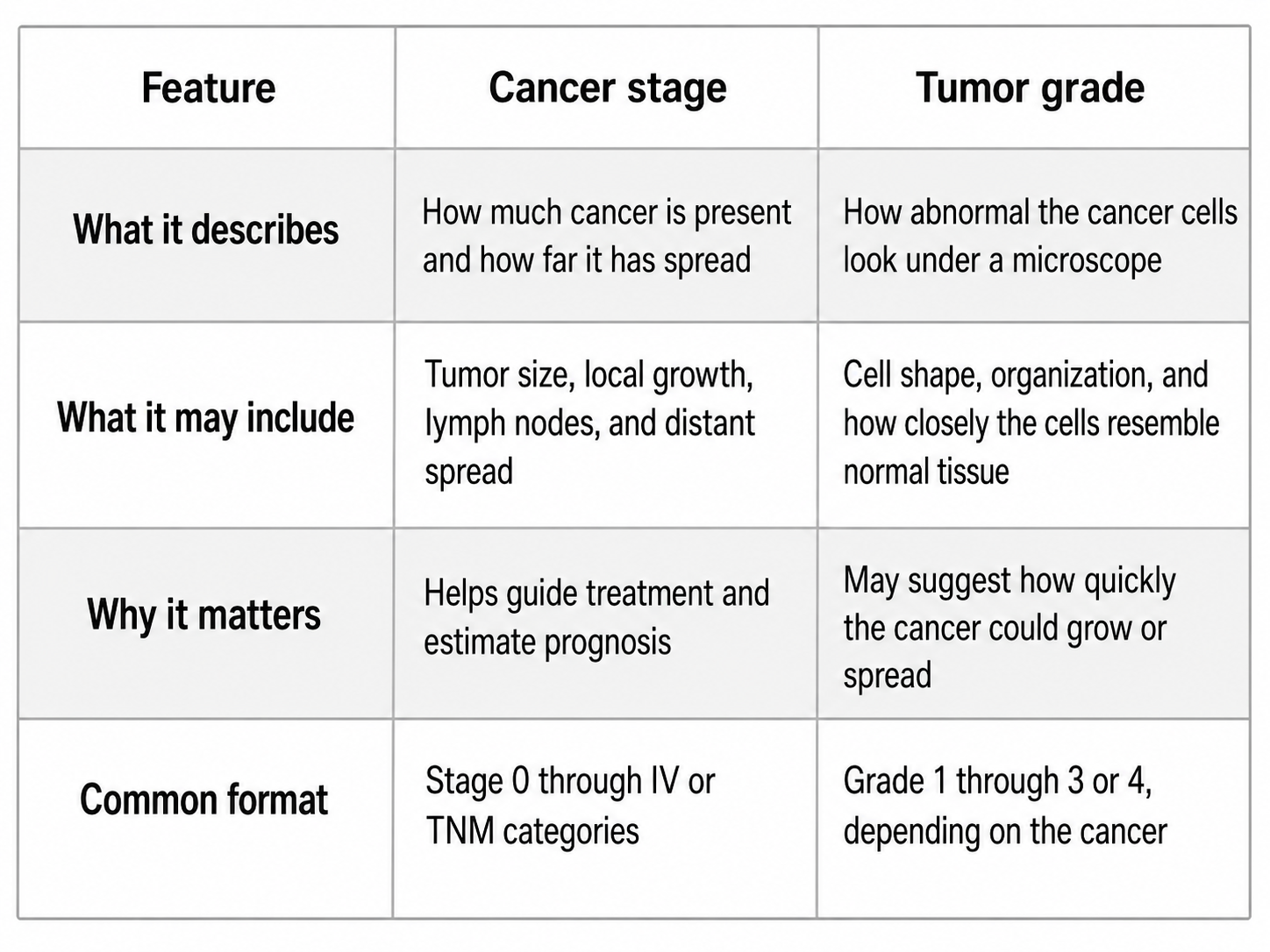
In general, low-grade cancer cells look more like normal cells and may grow more slowly. High-grade cells look more abnormal and may be more likely to grow quickly.
A high-grade tumor is not the same thing as a high-stage cancer.
A small cancer that has not spread could be early stage but high grade. Another cancer could be more advanced in stage but have a lower grade. Doctors may use both stage and grade when recommending treatment.
Can a Cancer Stage Change?
The original stage assigned at diagnosis usually remains part of the permanent medical record.
Cancer may later:
Respond to treatment
Continue growing
Return after treatment
Spread to another part of the body
Doctors may order new tests and perform restaging to describe the cancer’s current extent. They may also use terms such as recurrent, progressive, advanced, or metastatic cancer.
However, the new information does not usually erase or replace the original stage. Instead, it is added to the medical record. The stage at diagnosis remains important when doctors discuss treatment history and population survival statistics.
For example, someone originally diagnosed with Stage II cancer may later develop distant metastatic disease. The medical record may describe the cancer as recurrent or metastatic while still noting that the original diagnosis was Stage II.
Staging systems themselves can also be revised as researchers learn more about cancer biology and outcomes. A change in staging guidelines does not necessarily mean that an individual person’s cancer has physically changed.
What Does Cancer Stage Mean for Prognosis?
Prognosis is an estimate of how a disease may affect a person and how it may respond to treatment.
Cancer stage is an important part of prognosis, but it is only one factor.
Doctors may also consider:
The cancer type and subtype
Tumor biology
Biomarkers and genetic changes
Tumor grade
The patient’s age
Overall health and other medical conditions
Available treatment options
How the cancer responds to treatment
Whether the cancer has returned
New therapies or clinical trials
Survival rates are based on groups of people treated during a certain period. They can help doctors understand general patterns, but they cannot predict exactly what will happen to one individual.
Two people with the same cancer stage can have different outcomes because their cancers may have different biological features, their overall health may differ, and their responses to treatment may not be the same.
Statistics can also lag behind newer treatments. People diagnosed today may have treatment options that were not available when the data were collected.
Your oncology team is the best source for understanding how your stage, tumor biology, health, and treatment choices fit together.
Does Stage IV Cancer Always Mean Terminal?
No. Stage IV cancer does not automatically mean that a person is near death or that no treatment is available.
Stage IV generally means cancer has spread from where it began to a distant part of the body. It is serious and is often more difficult to treat than cancer that has remained in one area.
However, Stage IV cancer includes many different diseases.
Some metastatic cancers may respond well to treatment and can be controlled for extended periods. In other cases, treatment may focus on slowing the cancer, relieving symptoms, preventing complications, and maintaining quality of life. Other metastatic cancers may be more aggressive or more difficult to control.
How long someone may live with Stage IV cancer depends on factors such as:
The type and subtype of cancer
Where it has spread
Tumor biology and biomarkers
Available treatments
Response to treatment
Overall health
The term terminal cancer is generally used when the cancer can no longer be controlled and is expected to lead to death. It is not automatically interchangeable with Stage IV.
Ask your oncology team what Stage IV means for your particular cancer rather than relying on general information from another cancer type.
Questions to Ask Your Oncology Team
A cancer diagnosis often comes with unfamiliar letters, numbers, and medical terms. Consider bringing this list to your next appointment:
What is my complete TNM classification?
What is my overall cancer stage?
Is this a clinical stage or a pathological stage?
What is the tumor grade?
Were biomarkers or molecular test results used to determine my stage?
How does my stage affect my treatment options?
Does my stage affect my eligibility for clinical trials?
Are more tests needed before my stage is final?
What does this stage mean for my specific type and subtype of cancer?
Where can I find trustworthy information about my diagnosis?
You may also want to ask your doctor to write the complete diagnosis down. Recording the appointment may help, but ask the care team for permission first.
Frequently Asked Questions
What is the difference between Stage I and Stage IV cancer?
Stage I cancer is generally limited to the organ where it began and has not spread far. Stage IV cancer has generally spread to a distant organ or part of the body. Exact definitions and treatment implications vary by cancer type.
What does Stage 0 cancer mean?
Stage 0 usually means abnormal cells are present but have not invaded nearby tissue. This is often called carcinoma in situ. It may require treatment because some in situ changes can eventually become invasive, although the risk and treatment depend on the cancer type.
Is Stage IV cancer always terminal?
No. Stage IV means the cancer has spread to a distant part of the body. It is serious, but it does not automatically determine how long a person will live. Some metastatic cancers can be controlled for long periods, while others are harder to treat.
Can cancer skip stages?
Cancer does not necessarily progress through every numbered stage in a predictable order. A cancer may already be Stage III or Stage IV when it is first detected. It did not necessarily “skip” a stage; it may simply not have been found while it was smaller or more limited.
Can two people with the same stage have different outcomes?
Yes. Outcome can also be affected by cancer subtype, tumor biology, biomarkers, grade, age, general health, available treatments, and response to treatment.
What is the difference between cancer stage and grade?
Stage describes how much cancer is present and how far it has spread. Grade describes how abnormal the cancer cells look under a microscope and may provide information about how quickly they could grow.
What does TNM stand for?
TNM stands for Tumor, Nodes, and Metastasis. T describes the primary tumor, N describes nearby lymph-node involvement, and M describes whether the cancer has spread to a distant part of the body.
Does every cancer use the TNM system?
No. TNM is used mainly for solid tumors. Blood cancers, brain tumors, some childhood cancers, and certain other cancers may use different staging or classification systems.
A Final Reminder
Cancer staging gives your medical team a shared language for describing the extent of cancer and planning care. It is important, but it is not the complete story.
Ask for your full diagnosis, including the cancer type, subtype, TNM classification, overall stage, tumor grade, and biomarker results. These details will give you a clearer and more useful picture than the stage number alone.
This article is for educational purposes and is not a substitute for medical advice. Discuss questions about your diagnosis, prognosis, or treatment with your oncology team.
References
National Cancer Institute. “Cancer Staging.” Updated October 14, 2022.
National Cancer Institute. “Tumor Grade.” Updated August 1, 2022.
National Cancer Institute. “Understanding Cancer Prognosis.” Updated May 29, 2024.
American Cancer Society. “Cancer Staging.” Updated September 10, 2024.
American Cancer Society. “What Are Advanced and Metastatic Cancers?” Updated July 22, 2025.
Surveillance, Epidemiology, and End Results Program. “Basics of Staging.” Reviewed March 4, 2024.
For more information on how HuMOLYTE can support your gut health during chemotherapy, visit our product page or consult your health care provider.
This blog was reviewed by Dr. Sourabh Kharait.
This blog is for educational purposes only and is not intended as medical advice. Always consult with your healthcare provider before making any changes to your treatment plan, hydration strategies, or diet. The information provided here is based on general insights and may not apply to individual circumstances.
