
WHO Oral Mucositis Grading Scale: Understanding Grades 0–4
Mouth soreness during chemotherapy can start as mild redness and progress to painful ulcers that make eating and drinking difficult.
But how do doctors describe how severe oral mucositis has become?
One commonly used method is the World Health Organization (WHO) oral mucositis grading scale, sometimes called the WHO Oral Toxicity Scale. It classifies oral mucositis from Grade 0 to Grade 4, based on visible changes in the mouth and, importantly, how those changes affect a patient's ability to eat and drink.
That last part matters. Mucositis is not simply a question of how a patient's mouth looks. Once mouth sores interfere with nutrition and hydration, the clinical consequences can become much more significant.
What Is the WHO Mucositis Grading Scale?
The WHO oral mucositis grading scale is a five-level system, from Grade 0 through Grade 4, used to describe the severity of oral mucositis.
In simple terms:
Grade 0: No oral mucositis
Grade 1: Redness and soreness
Grade 2: Redness and ulcers, but the patient can still eat solid food
Grade 3: Ulcers severe enough that the patient requires a liquid diet
Grade 4: Oral intake of solids or liquids is no longer possible
The National Cancer Institute includes the WHO system among the established scales used to evaluate oral mucositis in people receiving cancer treatment.
WHO Oral Mucositis Grading Chart
These definitions follow the WHO grading criteria summarized by the National Cancer Institute.
WHO Grade 0 Mucositis: No Visible Mucositis
WHO Grade 0 means there are no clinical findings of oral mucositis.
The tissues inside the mouth appear normal, and the patient is generally able to eat and drink normally.
Grade 0 does not necessarily mean that a patient will remain free of mucositis throughout treatment. Oral complications can develop as chemotherapy or radiation progresses, which is why oncology teams may continue to evaluate the mouth throughout treatment.
WHO Grade 1 Mucositis: Redness and Soreness
Grade 1 oral mucositis is characterized by redness, also called erythema, and soreness.
At this stage, a patient may notice that the mouth feels more sensitive than normal. Certain foods, particularly spicy, acidic, salty, or very hot foods, may become uncomfortable.
There may not yet be obvious ulcers.
Grade 1 can be easy to dismiss as "just a sore mouth," but tracking early changes can be useful because mucositis may progress during cancer treatment.
WHO Grade 2 Mucositis: Ulcers, but Solid Food Is Still Possible
WHO Grade 2 mucositis involves oral redness and ulcers, but the patient can still eat solid foods.
This is an important point in the grading scale.
Visible ulcers have developed, and eating may be painful, but oral intake is still possible. Patients may naturally begin choosing softer or less irritating foods even though they technically remain able to eat solids.
The National Cancer Institute distinguishes this from Grade 3, where ulcers become severe enough that solid food can no longer be tolerated.
WHO Grade 3 Mucositis: A Liquid Diet Is Required
WHO Grade 3 oral mucositis means ulcers have become severe enough that the patient requires a liquid diet.
This represents a meaningful change in function.
The difference between Grade 2 and Grade 3 is not simply whether the mouth sores look worse. The patient's ability to eat has changed.
This can create additional concerns involving:
Calorie intake
Protein intake
Hydration
Electrolyte balance
Weight loss
Pain control
Ability to take medications by mouth
The NCI notes that oral complications become particularly serious when they interfere with eating or drinking because this can contribute to dehydration and malnutrition.
WHO Grade 4 Mucositis: Oral Intake Is Not Possible
WHO Grade 4 represents the most severe category on the WHO oral mucositis scale.
At Grade 4, ulcers and oral injury are severe enough that the patient cannot tolerate solid or liquid intake by mouth.
This is very different from simply having painful mouth sores.
If a patient cannot maintain fluid or nutritional intake, the oncology team may need to address hydration, nutrition, pain and other complications.
NCI guidance advises patients to contact their healthcare team when mouth or throat pain makes it difficult to eat or drink.
Why Does the WHO Scale Include Eating and Drinking?
One of the useful features of the WHO mucositis scale is that it combines physical findings with function.
A clinician is not simply asking:
"How many ulcers are present?"
The scale also asks, in effect:
"Can this patient still eat?"
That distinction makes sense clinically because two patients can have mouth ulcers that appear similar but experience very different effects on daily life.
One may continue eating almost normally.
Another may struggle to drink enough water.
By Grades 3 and 4, oral mucositis has moved beyond discomfort and is beginning to interfere directly with nutrition and hydration.
Why Oral Mucositis Matters During Cancer Treatment
Oral mucositis is inflammation and injury of the mucous membranes lining the mouth. It can occur with chemotherapy as well as radiation therapy, particularly radiation involving the head and neck.
Symptoms can include:
Mouth redness
Burning or tenderness
Pain
Ulcers
Difficulty chewing
Difficulty swallowing
Difficulty eating
Difficulty drinking
Severe oral mucositis may contribute to dehydration, inadequate nutrition and infection risk. In some circumstances, oral complications can also contribute to cancer treatment modification or interruption.
That is one reason clinicians and researchers try to measure mucositis consistently rather than simply recording that a patient has "mouth sores."
WHO Mucositis Scale vs. OMAS
The WHO scale is not the only system used to measure oral mucositis.
Another is the Oral Mucositis Assessment Scale, or OMAS.
The two tools answer somewhat different questions.
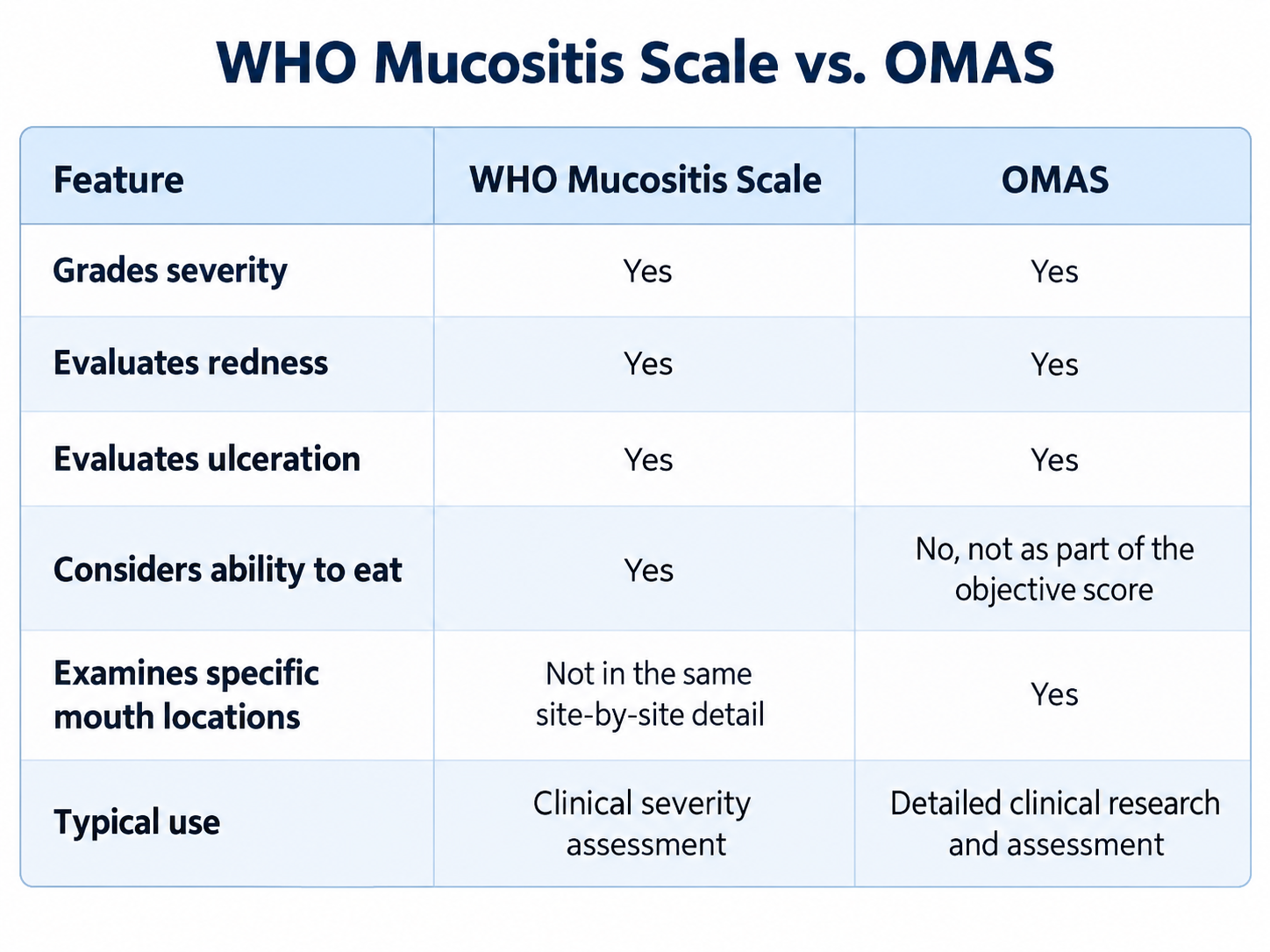
The easiest way to think about the difference is this:
WHO grading gives you the big picture. OMAS gives you a more detailed map.
OMAS evaluates erythema and ulceration across multiple locations inside the mouth. That can make it useful when researchers want to measure relatively small changes in mucosal injury.
The WHO scale is simpler and incorporates something immediately meaningful to both clinicians and patients: whether the person can still eat and drink.
WHO Mucositis Scale vs. NCI CTCAE
Cancer researchers and oncology teams may also use the National Cancer Institute Common Terminology Criteria for Adverse Events (CTCAE).
The systems are similar, but they are not identical.
For example, the NCI's comparison of oral mucositis scales describes CTCAE Grade 2 as moderate pain that does not interfere substantially with oral intake, while Grade 3 involves severe pain that does interfere with oral intake.
The WHO system places greater emphasis on whether the patient can tolerate solid food, requires a liquid diet or cannot tolerate oral intake at all.
This is one reason a research paper should always state which mucositis grading system was used rather than simply reporting "Grade 2" or "Grade 3."
Those numbers do not necessarily mean exactly the same thing across every scale.
Does a Higher WHO Grade Mean Cancer Treatment Must Stop?
Not necessarily.
A mucositis grade is one piece of clinical information.
An oncology team may also consider factors such as:
Cancer treatment being used
Treatment schedule
Pain severity
Ability to swallow
Hydration status
Nutritional status
Infection
Blood counts
Other treatment side effects
Overall medical condition
Oral complications can sometimes contribute to treatment modification, but a WHO mucositis grade by itself does not determine whether chemotherapy or radiation should continue.
That decision belongs to the patient's oncology team.
When Should a Patient Contact Their Cancer Care Team?
Patients should not wait until mucositis reaches Grade 3 or Grade 4 before mentioning symptoms.
The National Cancer Institute recommends contacting a doctor or nurse when mouth, lip or throat pain makes it difficult to eat, drink or sleep, or when fever develops.
The American Cancer Society similarly recommends telling the cancer care team about persistent redness, sores, difficulty eating or drinking, problems taking medication, or fever.
Early reporting gives the care team an opportunity to evaluate what is happening before oral intake becomes severely compromised.
Mucositis Research and HuMOLYTE
Researchers are continuing to investigate approaches that may help protect the mucosal barrier during chemotherapy.
A peer-reviewed 2026 study published in Frontiers in Nutrition evaluated HuMOLYTE®, a medical food containing 2′-fucosyllactose (2′-FL), magnesium and electrolytes, in Wistar rats receiving several chemotherapy drugs.
Researchers reported less gastrointestinal mucosal injury, reduced inflammatory changes, preservation of goblet cells and mucosal architecture, and reduced chemotherapy-associated oral mucosal changes in animals receiving HuMOLYTE compared with controls.
It is important to distinguish these findings from the WHO scale discussed in this article. The published study was preclinical and did not establish that HuMOLYTE reduces WHO oral mucositis grades in human patients.
That is exactly why standardized measures such as WHO grading, CTCAE and OMAS matter: they allow future clinical research to describe changes in mucositis in consistent, measurable terms.
Frequently Asked Questions About WHO Mucositis Grading
What are the WHO grades for oral mucositis?
The WHO oral mucositis scale runs from Grade 0 to Grade 4. Grade 0 means no mucositis. Grade 1 involves redness and soreness. Grade 2 includes ulcers while solid food remains possible. Grade 3 requires a liquid diet. Grade 4 means oral intake of solids or liquids is not possible.
What is WHO Grade 1 mucositis?
WHO Grade 1 mucositis means the mouth has developed redness and soreness, but ulcers severe enough to interfere substantially with eating have not developed.
What is WHO Grade 2 mucositis?
WHO Grade 2 means oral redness and ulcers are present, but the patient can still eat solid food.
What is WHO Grade 3 mucositis?
WHO Grade 3 means oral ulcers are severe enough that the patient requires a liquid diet because solid food can no longer be tolerated.
What is WHO Grade 4 mucositis?
WHO Grade 4 means mucositis is severe enough that the patient is unable to tolerate solid or liquid intake by mouth.
What is the difference between Grade 2 and Grade 3 mucositis?
The key distinction is the ability to eat solid food. With Grade 2, solid food remains possible. With Grade 3, ulcers require the patient to switch to a liquid diet.
Is WHO Grade 4 mucositis serious?
Yes. Grade 4 indicates that a patient cannot maintain normal oral food or fluid intake. Problems eating and drinking can contribute to dehydration and malnutrition and should be addressed promptly by the cancer care team.
Is the WHO scale the same as OMAS?
No. WHO grading provides a broad measure of severity and eating ability. OMAS provides a more detailed assessment of redness and ulceration at specific locations throughout the mouth.
Is the WHO scale the same as CTCAE?
No. They measure similar treatment-related toxicity but use somewhat different criteria. A Grade 3 on one scale should therefore not automatically be assumed to be identical to Grade 3 on another.
The Bottom Line
The WHO oral mucositis grading scale turns a complicated cancer-treatment side effect into a relatively simple 0-to-4 framework.
But the most important part of the scale may not be the number.
It is the transition from mouth soreness, to ulcers, to difficulty eating, and finally to difficulty maintaining oral nutrition and hydration.
For patients undergoing chemotherapy or radiation therapy, that progression is worth paying attention to.
Mouth sores should not simply be accepted as something a patient has to endure. Tell your cancer care team when symptoms begin, particularly when they start changing what or how much you can eat or drink.
References
For more information on how HuMOLYTE can support your gut health during chemotherapy, visit our product page or consult your health care provider.
This blog was reviewed by Dr. Sourabh Kharait.
This blog is for educational purposes only and is not intended as medical advice. Always consult with your healthcare provider before making any changes to your treatment plan, hydration strategies, or diet. The information provided here is based on general insights and may not apply to individual circumstances.
