
Fructose and Cancer Growth: What a Laboratory Study Really Found
A laboratory and animal study found that fructose may support tumor growth indirectly. Many of the cancer cells studied could not use fructose efficiently on their own. Instead, the liver processed fructose and released fats called lipids into the blood. Some tumor cells then used those lipids to build new cell membranes and support growth.
The research involved mice, zebrafish, and cells grown in laboratory dishes—not cancer patients. It does not prove that eating fructose causes cancer, that avoiding sugar treats cancer, or that patients should stop eating fruit.
What Did the Study Find?
The study was published in the journal Nature in December 2024. Researchers examined how dietary fructose affected several cancer models.
They used:
Mice
Zebrafish
Human cancer cells grown in laboratory dishes
Liver cells studied alongside cancer cells
The researchers found that fructose supplementation increased tumor growth in animal models of melanoma, breast cancer, and cervical cancer.
However, many of the cancer cells could not efficiently use fructose directly. They lacked enough of a form of the enzyme ketohexokinase, or KHK, that is needed to break fructose down.
An enzyme is a protein that helps a chemical reaction happen in the body.
Liver cells did have the needed enzyme. These cells processed the fructose and released several types of lipids. Tumor cells absorbed some of those lipids and used them to build materials needed for cell division.
This was preclinical research, meaning it was conducted in animals and laboratory-grown cells before being tested in people.
Why Was the Liver Involved?
The liver plays an important role in fructose metabolism.
Metabolism is the process the body uses to break down food and turn it into energy or other materials.
After fructose is absorbed from the digestive tract, much of it is processed by the small intestine and liver. Liver cells contain KHK-C, a form of ketohexokinase that helps break fructose down.
In the study, liver cells converted fructose into several lipid compounds.
Lipids are fats and fat-like substances. The body uses them for energy, hormones, cell membranes, and many other functions.
The researchers paid particular attention to lysophosphatidylcholines, or LPCs. LPCs are lipid molecules that can circulate in the blood.
The tumor cells absorbed LPCs and used them to make phosphatidylcholines. These are major parts of cell membranes—the thin outer layers surrounding cells.
A rapidly dividing tumor cell needs materials to build new membranes. In these models, the liver supplied some of those materials after processing fructose.
This does not mean the liver itself was cancerous. The liver was acting as a metabolic processing center.
Which Cancer Types Were Studied?
The researchers used animal and laboratory models involving:
Melanoma, a type of skin cancer
Breast cancer
Cervical cancer
The researchers were studying tumors located outside the liver and how those tumors might benefit from nutrients made by another organ.
The liver played a metabolic role, but this was not a study showing that fructose directly fueled liver cancer.
Describing this research as proof that fructose feeds liver cancer would be misleading. Liver cells processed the fructose, but the main tumor models involved skin, breast, and cervical cancers.
Was the Research Conducted in People?
No.
The study involved mice, zebrafish, cancer cells grown in laboratory dishes, and liver cells studied alongside cancer cells.
Animal and cell studies are valuable because they help researchers examine biological mechanisms under controlled conditions. They can show researchers what may be happening and identify questions worth studying in clinical trials.
However, these models cannot fully reproduce the complexity of a person’s body, diet, cancer, medical history, medications, or treatment plan.
The study did not test whether reducing fructose in cancer patients:
Slows tumor growth
Improves survival
Improves the response to chemotherapy, radiation, or immunotherapy
Prevents cancer recurrence
Reduces treatment side effects
The clinical significance—the real-world meaning for patients—remains unknown.
Does Sugar Feed Cancer?
The phrase “sugar feeds cancer” contains a small piece of biology but often leads to an inaccurate conclusion.
Cancer cells use nutrients to grow. Many cancer cells consume large amounts of glucose, a basic sugar used for energy.
Normal cells also need glucose. Your brain, muscles, blood cells, and other tissues rely on it.
Even when a person stops eating sweets or carbohydrates, the body can make glucose from stored energy, protein, and other nutrients. Blood glucose does not simply disappear because dessert is removed from the diet.
Think of the body as a city with several power plants. Closing one road does not shut off electricity to one building. The body can reroute and produce fuel through several pathways.
Cancer metabolism is far more complicated than “sugar in, tumor growth out.”
Patients cannot starve cancer by removing all sugar from the diet.
The National Cancer Institute states that studies have not shown that eating sugar makes cancer worse or that stopping sugar causes cancer to shrink or disappear.
Does Fructose Cause Cancer?
This study does not prove that fructose causes cancer.
There is an important difference between:
Causing a healthy cell to become cancerous
Supporting the growth of an existing tumor in an animal model
Being associated with broader health risks when consumed in excess
The Nature study focused mainly on the second question. It examined whether fructose could support the growth of existing tumors in preclinical models.
Cancer risk is usually evaluated using many types of evidence, including population studies, laboratory research, animal studies, and human clinical research. One animal study cannot establish that a particular food or nutrient causes cancer in people.
High intake of added sugar may contribute to excess calorie intake and weight gain. Excess body weight is associated with a higher risk of several cancers. That is different from saying that fructose directly causes cancer.
Does This Mean People Should Stop Eating Fruit?
No.
Whole fruit contains fructose, but it also provides:
Water
Fiber
Vitamins
Minerals
Plant compounds
Nutrients that support overall health
A whole apple is consumed and digested differently from a large sweetened drink. Whole fruit generally contains less sugar per serving than many sweetened beverages and is eaten more slowly.
The study used controlled fructose exposure in animals. It did not test ordinary servings of whole fruit in cancer patients.
It also did not show that fruit promotes tumor growth.
The study is not a reason to eliminate whole fruit from the diet.
The National Cancer Institute’s coverage of the study specifically cautioned readers not to use the findings as a reason to remove all fructose from their diets.
People with diabetes, digestive conditions, liver disease, swallowing problems, or other medical needs may require individualized advice.
Fructose, Table Sugar, and High-Fructose Corn Syrup
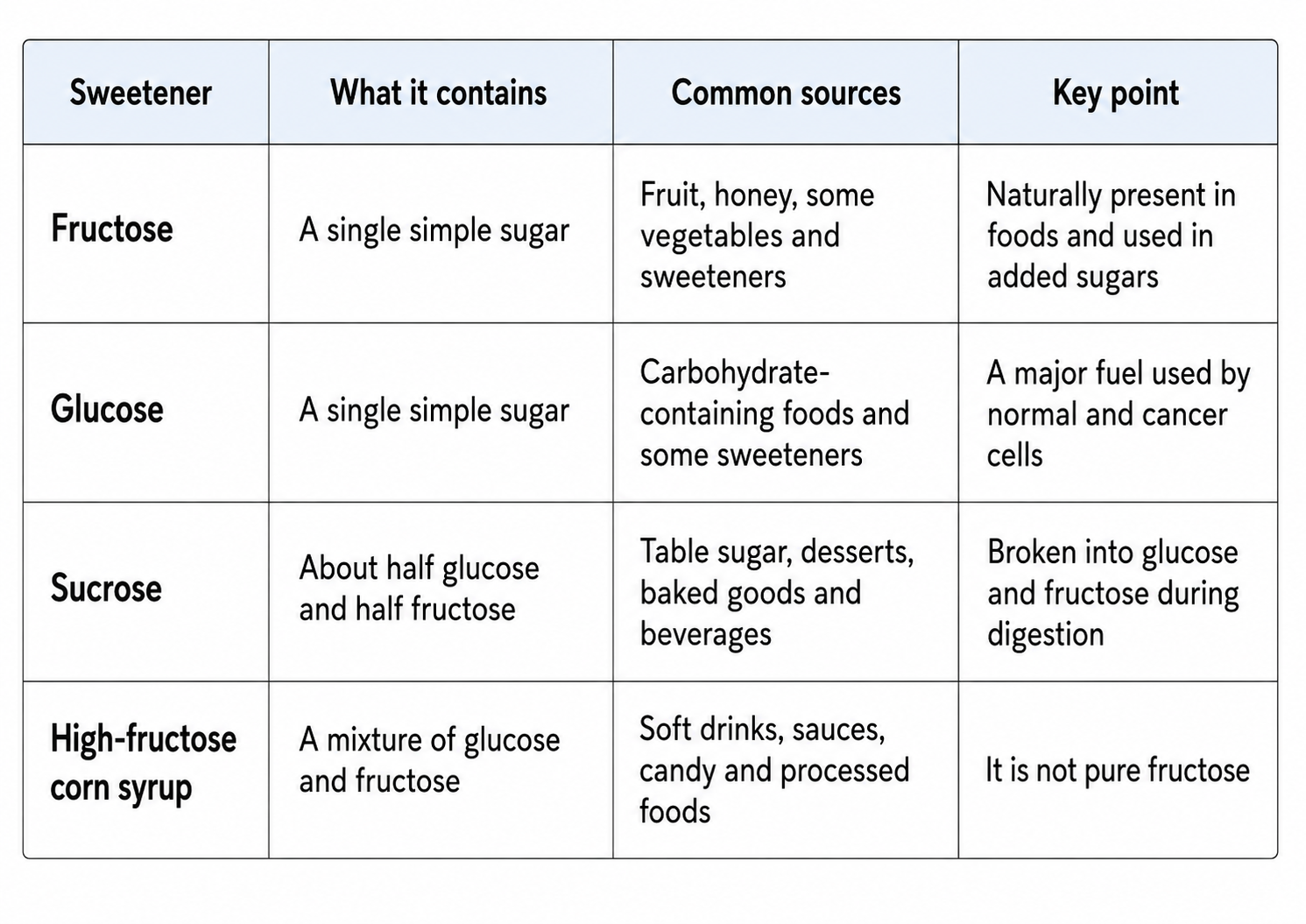
The word “sugar” can describe several different carbohydrates.
Fructose is a simple sugar naturally found in fruit, honey, and some vegetables. It is also present in added sweeteners.
Glucose is a simple sugar used by cells throughout the body as a major source of energy.
Sucrose, commonly called table sugar, is made from one glucose molecule joined to one fructose molecule.
High-fructose corn syrup, or HFCS, is a liquid sweetener made from corn starch. Despite its name, it is not pure fructose. Common forms contain both glucose and fructose.
From a practical nutrition standpoint, it is usually more useful to focus on total added sugar than to fear one ingredient.
Sweetened drinks and highly processed foods may contain sucrose, corn syrup, HFCS, concentrated fruit juice, or several other added sugars.
What the Study Does Not Prove
The study does not prove that:
Fructose causes cancer
Whole fruit promotes cancer growth
A low-fructose diet treats cancer
Avoiding sugar can starve a tumor
The same mechanism occurs to the same extent in people
People with liver cancer should automatically avoid fructose
Reducing fructose improves survival
Reducing fructose improves treatment response
Dietary changes can replace prescribed cancer treatment
The researchers also tested an experimental drug called PF-06835919, which blocks KHK activity.
In the animal models, blocking KHK lowered circulating LPC levels and reduced the tumor-growth effect associated with fructose. That finding may help researchers study new treatments, but PF-06835919 is not an approved cancer treatment based on this research.
Should Cancer Patients Reduce Added Sugar?
Reducing excessive added sugar can be part of a healthy eating pattern, but cancer patients generally do not need to eliminate every food containing sugar.
Practical steps include:
Replace sugar-sweetened drinks when appropriate. Choose water or another beverage recommended by your care team.
Check nutrition labels. The “Added Sugars” line can help you compare similar products.
Choose whole fruit more often. Whole fruit generally offers more nutrition than fruit drinks, candy, or fruit-flavored snacks.
Limit heavily processed snacks and desserts. These foods can provide many calories while offering limited protein, fiber, vitamins, or minerals.
Avoid extreme restrictions during treatment. Cutting out entire food groups may make it harder to get enough calories and protein.
Ask an oncology dietitian for personal guidance. Advice should account for your cancer type, treatment, weight, symptoms, medications, and other conditions.
General federal dietary guidance has recommended limiting added sugars to less than 10% of daily calories. Cancer treatment may change nutrition priorities, however, so this target should not replace personalized medical advice.
When Nutrition Needs May Be Different During Cancer Treatment
Cancer and its treatment can make eating difficult.
Nutrition priorities may change when a patient has:
Poor appetite
Unintended weight loss
Mouth sores
Trouble chewing or swallowing
Nausea or vomiting
Changes in taste or smell
Diarrhea or constipation
Cachexia
Only a few tolerated foods
Cachexia is a cancer-related condition that can cause severe loss of muscle, weight, strength, and appetite.
In these situations, calorie-dense foods, nutrition shakes, soft foods, or sweetened drinks may help a patient meet immediate nutrition needs. A patient who is losing weight should not automatically remove foods that are providing needed calories.
Maintaining protein, calories, hydration, and strength may be more urgent than avoiding every source of added sugar.
During treatment, the best diet is often the one that safely helps the patient meet calorie, protein, and fluid needs.
The National Cancer Institute notes that people with cancer may need more protein and calories than usual and may need a diet that looks different from standard healthy-eating advice.
What About People With Liver Cancer?
This study does not establish a special liver-cancer diet.
People with liver cancer may have unique nutrition needs because of:
Reduced liver function
Fluid retention
Poor appetite
Unintended weight loss
Muscle loss
Treatment side effects
Diabetes or other medical conditions
Difficulty processing certain nutrients or medications
Recommendations may depend on the person’s liver function, stage of disease, treatment plan, sodium needs, fluid balance, and overall nutrition status.
People with liver cancer should not automatically eliminate fructose or fruit based on this study. They should discuss dietary changes with their oncologist, hepatologist, and a registered dietitian experienced in cancer care.
Questions to Ask an Oncology Dietitian
Should I limit added sugar during treatment?
Is whole fruit appropriate for me?
Am I eating enough calories and protein?
Could a restrictive diet cause weight loss or weakness?
Are sweetened nutrition drinks appropriate in my situation?
Should I avoid any foods because of my treatment?
Would a low-carbohydrate or ketogenic diet be safe for me?
How should I manage diabetes during cancer treatment?
What should I eat if I have nausea or mouth sores?
How can I make realistic dietary changes without losing weight?
Frequently Asked Questions
Does fructose cause cancer?
The study does not prove that fructose causes cancer. It found that fructose indirectly supported the growth of existing tumors in animal and laboratory models.
Does sugar make cancer grow faster?
Cancer cells use nutrients, including glucose, but human studies have not shown that eating sugar directly makes a person’s cancer grow faster. Diet may affect health and cancer risk through several pathways, including body weight.
Can avoiding sugar starve a tumor?
No. The body continues to produce and regulate glucose even when sweets or carbohydrates are restricted. Eliminating sugar cannot selectively remove fuel from cancer cells.
Should cancer patients stop eating fruit?
Not based on this study. Whole fruit provides water, fiber, vitamins, minerals, and other nutrients. Individual restrictions should be discussed with the care team.
What is high-fructose corn syrup?
High-fructose corn syrup is a sweetener made from corn starch. It contains both glucose and fructose and is commonly used in sweetened beverages and processed foods.
Which cancers were studied?
The study included animal and laboratory models of melanoma, breast cancer, and cervical cancer.
Was the study conducted in humans?
No. It used mice, zebrafish, cancer cells, and liver cells. The clinical significance in people is unknown.
Should people with liver cancer avoid fructose?
The study does not support an automatic fructose restriction for people with liver cancer. Nutrition recommendations should be personalized according to liver function, treatment, symptoms, and overall health.
Are artificial sweeteners better than sugar?
Artificial sweeteners may reduce sugar or calorie intake in some situations, but they are not necessary for everyone. Safety, tolerance, diabetes management, digestive symptoms, and overall diet should be considered. The NCI reports that approved artificial sweeteners have been extensively studied, although questions may differ by sweetener and amount consumed.
Should cancer patients follow a low-carbohydrate diet?
Not without guidance from the oncology team. Restrictive diets may cause unwanted weight loss, weakness, or nutrient gaps. Evidence is not strong enough to recommend a low-carbohydrate or ketogenic diet as a standard cancer treatment.
The Bottom Line
The study identified an interesting pathway: in preclinical models, the liver converted fructose into lipids that some tumors used to support cell growth.
That finding may help scientists understand cancer metabolism and explore possible treatments. It does not prove that fructose causes cancer, that fruit feeds tumors, or that patients can starve cancer by avoiding sugar.
For most people, the practical approach is to limit excessive added sugar while continuing to eat a balanced diet. During cancer treatment, maintaining weight, strength, hydration, calories, and protein may take priority over strict dietary rules.
Always discuss major dietary changes with your oncology team or a registered oncology dietitian.
5. References
National Cancer Institute. “Common Cancer Myths and Misconceptions.” Updated July 24, 2024.
National Cancer Institute. “Nutrition During Cancer.” Updated October 15, 2024.
American Cancer Society. “Sugar, Processed Foods, and Cancer Risk.” Updated October 17, 2025.
National Cancer Institute. “Artificial Sweeteners and Cancer.” Updated August 29, 2023.
National Cancer Institute. “Eating Hints: Before, During, and After Cancer Treatment.”
National Cancer Institute. “Cachexia and Cancer.” Updated October 15, 2024.
For more information on how HuMOLYTE can support your gut health during chemotherapy, visit our product page or consult your health care provider.
This blog was reviewed by Dr. Sourabh Kharait.
This blog is for educational purposes only and is not intended as medical advice. Always consult with your healthcare provider before making any changes to your treatment plan, hydration strategies, or diet. The information provided here is based on general insights and may not apply to individual circumstances.
